Ghosting Routines That Actually Improve Your Court Movement
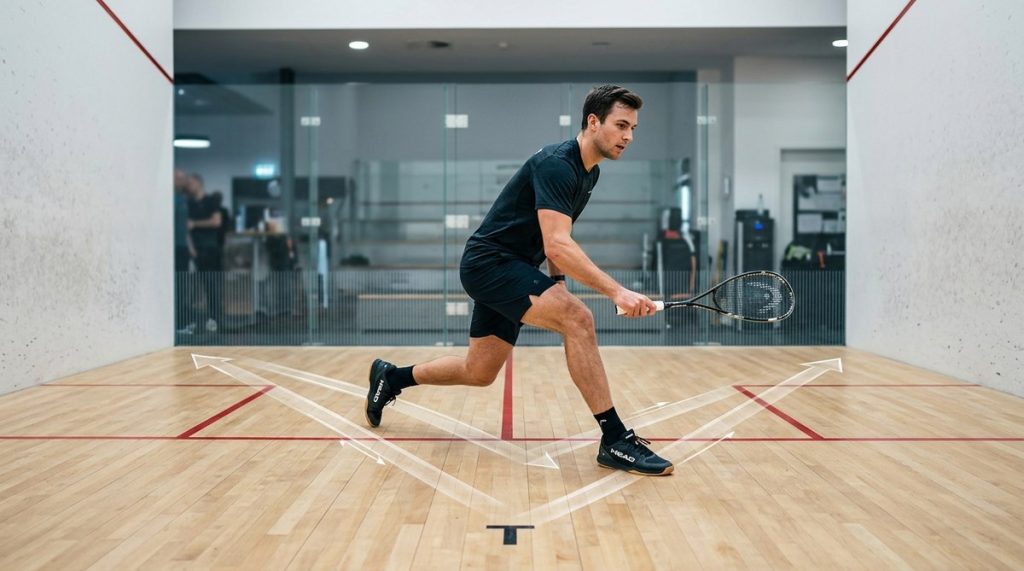
Ghosting gets dismissed as mindless running around an empty court. But when you approach it with structure and intent, it becomes the most effective solo training method for building explosive movement, sharpening footwork patterns, and developing the court awareness that separates intermediate players from advanced competitors.
Effective squash ghosting routines replicate realistic rally patterns rather than predictable star drills. Focus on varying shot heights, starting each sequence with a serve, keeping most rallies under seven shots, and prioritising smooth weight transfer over pure speed. Structured solo practice builds muscle memory that translates directly into match performance when combined with proper recovery positioning.
Why Most Ghosting Routines Fail to Translate to Matches
The traditional star pattern has dominated squash training for decades. You touch each corner in sequence, return to the T, and repeat until exhausted.
The problem? Real rallies never follow predictable patterns.
Your opponent doesn’t politely wait for you to return to the T before hitting their next shot. They exploit gaps in your positioning. They vary pace and height. They force you to adjust mid-movement.
Effective ghosting mimics these unpredictable elements. You need to simulate the decision making, the sudden direction changes, and the varied recovery distances that define actual match play.
The routines below focus on realistic movement patterns that address the specific challenges you face during competitive rallies.
Building Your Foundation with Serve-Based Sequences
Every rally in squash begins with a serve or return. Yet most ghosting routines skip this crucial starting point entirely.
Starting from a serve position forces you to practice the exact movement patterns you’ll use in matches. Here’s how to structure it properly:
- Position yourself in the service box as if preparing to serve
- Simulate your serve motion (no ball needed)
- Move to cover the anticipated return (typically straight drive or crosscourt)
- Continue the imagined rally for five to seven shots
- Return to the service box and begin again
This approach builds the specific footwork patterns you need when transitioning from serve to rally. You’ll develop better anticipation for where opponents typically return your serve.
Alternate between forehand and backhand service boxes. Your movement patterns differ significantly depending on which side you serve from.
The Mental Rally Technique That Changes Everything
The biggest mistake in ghosting is treating it as pure cardio. You run to corners without context, without imagining the ball, without making tactical decisions.
“Ghost as if you’re playing a rally against an invisible opponent. See the ball in your mind. React to their shot selection. Make tactical decisions about where to move next.” – Professional coach advice on realistic movement training
This mental component transforms ghosting from physical exercise into tactical practice.
When you move to the front right corner, visualise whether you’re playing a drop shot, a boast, or a kill. Each option requires different recovery positioning. A drop shot allows you to recover closer to the front. A boast forces you deeper and wider.
Your brain builds neural pathways for these tactical decisions. When match situations arise, your body responds automatically because you’ve rehearsed both the physical movement and the tactical context.
Structured Routines for Different Skill Levels
Intermediate Player Routine (20 Minutes)
This routine focuses on establishing consistent movement patterns and building the fitness foundation for longer rallies.
Warm-up Phase (5 minutes)
– Two minutes of gentle movement to all four corners
– Three minutes of ghosting simple straight drive patterns
– Focus on reaching the T between each shot
Main Training Block (12 minutes)
– Four sets of three-minute ghosting with one-minute rest between sets
– Each rally should last five to seven shots
– Start every sequence from the service box
– Emphasise smooth weight transfer rather than maximum speed
– Include mix of front court and back court movements
Cool-down (3 minutes)
– Slow-paced movement focusing on technique
– Practice split-step timing at the T
Advanced Player Routine (30 Minutes)
Advanced players need routines that challenge decision making and replicate the intensity of competitive matches.
Dynamic Warm-up (5 minutes)
– Movement patterns incorporating lunges and direction changes
– Gradual intensity increase to match heart rate
High-Intensity Blocks (20 minutes)
– Six sets of two-minute intensive ghosting
– One-minute active recovery between sets
– Vary rally length from three shots to twelve shots
– Include at least two direction changes per rally
– Practice both offensive (moving forward) and defensive (scrambling) patterns
– Simulate pressure situations where recovery to the T is compromised
Technical Focus (5 minutes)
– Slow-motion practice of specific movement patterns that felt awkward during high-intensity work
– Focus on hip rotation and shoulder positioning
Common Mistakes That Sabotage Your Progress
| Mistake | Why It Hurts | Correction |
|---|---|---|
| Always returning to centre T | Creates unrealistic movement patterns | Vary your recovery position based on shot played |
| Moving at constant speed | Doesn’t replicate match intensity | Use burst speed to the ball, controlled recovery |
| Ignoring shot height | Limits tactical awareness | Simulate high, medium, and low shot retrieval |
| Predictable corner sequences | Builds robotic movement | Randomise your shot selection |
| Skipping the split-step | Removes crucial timing element | Execute split-step before each imagined shot |
| Training only when fresh | Doesn’t prepare for late-game fatigue | Include ghosting sessions after other training |
The recovery position mistake deserves special attention. If you’ve just played a hard crosscourt drive, you shouldn’t recover all the way to the T. Your opponent likely won’t have time for a front corner shot. Position yourself slightly back and prepare for another drive or a boast.
This contextual positioning separates players who ghost effectively from those who simply run around.
Using Masking Tape to Build Precision
Visual targets transform vague movement into precise footwork. Place small pieces of masking tape at specific points on the court:
- Four tape marks in each corner (representing drop, kill, drive, and boast contact points)
- Two marks on each side wall (representing volley heights)
- Three marks along the back wall (representing different drive depths)
During your ghosting routine, aim to place your front foot within inches of the relevant tape mark. This precision training builds the exact footwork patterns you need for different shot types.
The tape also provides immediate feedback. If you consistently miss the mark, your movement pattern needs adjustment.
Replace the tape every few sessions. Old marks become invisible through familiarity, reducing their training value.
Integrating Shot Variety into Your Movement Patterns
Real rallies involve constant height variation. Your opponent mixes low kills with high lobs, forcing you to adjust your body position and footwork.
Practice these specific movement adjustments:
- Low shots: Deeper lunge, lower centre of gravity, explosive push-off
- Medium height: Standard ready position, balanced weight distribution
- High shots: More upright stance, focus on positioning rather than lunging
Spend entire ghosting sessions focusing on one height category. This concentrated practice builds the specific strength and technique needed for each situation.
Then combine all three heights in a single routine. The constant adjustment between high and low retrieval challenges your body in ways that single-height practice never achieves.
The Seven-Shot Rule for Realistic Training
Most recreational rallies last between four and eight shots. Professional rallies average slightly longer, but even at the elite level, extended rallies are the exception rather than the rule.
Structure your ghosting around this reality. Keep most imagined rallies under seven shots. This length allows you to maintain high intensity without sacrificing technique to fatigue.
Include occasional longer rallies (twelve to fifteen shots) to build the endurance needed for those grinding exchanges. But make these the exception, not the foundation of your training.
Shorter, high-quality rallies build better movement patterns than long, sloppy sequences where technique deteriorates.
Combining Ghosting with Technical Practice
Ghosting shouldn’t exist in isolation. The movement patterns you develop need to connect with actual shot execution.
Structure your training sessions to include both elements:
- Twenty minutes of structured ghosting
- Ten minutes of solo hitting focusing on the shots you ghosted
- Ten minutes of condition games that emphasise the movement patterns you practiced
This integration ensures your ghosting translates directly into improved match performance. Your body learns to connect specific movement patterns with specific shots, building the automaticity that defines advanced play.
The connection between movement and shot execution becomes particularly important when working on specific weaknesses. If your backhand volley keeps hitting the tin, ghost the movement pattern to that position repeatedly before adding the technical shot practice.
Progressive Overload for Movement Training
Like any physical training, ghosting requires progressive challenge to drive improvement. Simply repeating the same routine indefinitely leads to plateaus.
Apply these progression methods:
- Increase intensity: Move faster between shots while maintaining technique
- Reduce recovery time: Shorten rest periods between sets
- Add complexity: Include more direction changes per rally
- Extend duration: Gradually increase total training time
- Increase rally length: Build endurance with longer sequences
- Add resistance: Use weighted vest or resistance bands (advanced only)
Progress one variable at a time. Changing multiple elements simultaneously makes it impossible to identify what’s driving improvement or causing problems.
Track your ghosting sessions in a training diary. Note the routine structure, intensity level, and how you felt during and after. Patterns emerge that help you optimise your training schedule.
Creating Pressure Situations Through Ghosting
Match pressure affects movement quality. Your footwork deteriorates when you’re nervous, tired, or facing a crucial point.
Simulate pressure during ghosting:
- Set specific time targets for completing routines
- Ghost immediately after intensive fitness work when fatigued
- Practice specific match scenarios (serving to save game ball, defending a lead)
- Add consequence (if you don’t complete the routine properly, repeat it)
These pressure simulations build mental resilience alongside physical capability. Your movement patterns become more robust, less likely to break down during crucial match moments.
The psychological component of ghosting often gets overlooked. But the confidence you gain from knowing your movement is reliable under pressure translates directly into better match performance.
Footwork Patterns for Specific Tactical Situations
Different tactical situations require different movement patterns. Ghosting should address these variations specifically.
Attacking Position Movement
– Shorter, sharper steps
– Weight forward on toes
– Rapid direction changes
– Focus on front court coverage
Defensive Position Movement
– Longer strides to cover more court
– Lower centre of gravity
– Emphasis on reaching rather than positioning for attack
– Back court priority
Counter-Attacking Movement
– Explosive acceleration from defensive position
– Rapid transition from back foot to front foot
– Balance between reach and recovery
Dedicate specific ghosting sessions to each tactical category. This focused practice builds the movement vocabulary you need for different match situations.
The tactical awareness you develop through this approach influences shot selection. When you understand the movement implications of different shots, you make smarter tactical decisions. Developing touch and feel for drop shots becomes more valuable when you’ve ghosted the recovery patterns they create.
Weekly Training Structure for Optimal Results
Ghosting fits into a broader training programme. Balance it with other training elements to avoid overuse injuries and maintain progression.
Sample Weekly Structure:
- Monday: Technical shot practice (45 minutes)
- Tuesday: Structured ghosting routine (30 minutes) + condition games (20 minutes)
- Wednesday: Match play or competitive practice
- Thursday: Rest or light movement work
- Friday: High-intensity ghosting (20 minutes) + fitness work (20 minutes)
- Saturday: Match play or tournament
- Sunday: Active recovery or rest
Adjust this structure based on your competition schedule and recovery capacity. Older players or those with injury history need more recovery time between intensive ghosting sessions.
Listen to your body. Persistent fatigue, decreased performance, or joint pain indicates you need additional recovery time.
Equipment Considerations That Enhance Training
Proper footwear makes a significant difference in ghosting effectiveness and injury prevention. Court shoes designed specifically for squash provide the lateral support and grip needed for explosive direction changes.
Replace shoes regularly. Worn outsoles reduce grip and increase injury risk. Most players need new court shoes every three to four months with regular training.
Consider these additional tools:
- Heart rate monitor: Track intensity and recovery
- Interval timer: Structure work and rest periods precisely
- Video recording: Review movement patterns and identify technique issues
- Resistance bands: Add progressive overload to movement patterns
None of these tools are essential, but they can enhance training effectiveness when used appropriately.
Adapting Routines for Different Court Conditions
Court characteristics vary significantly. Glass-back courts play faster than traditional courts. Some facilities maintain warmer temperatures that affect ball bounce and player fatigue.
Adjust your ghosting to match the courts where you compete most frequently. If you play primarily on fast courts, emphasise explosive first-step speed and compact movement patterns. Slower courts reward longer rallies and sustained movement quality.
Temperature also matters. Warmer courts require more attention to hydration and potentially shorter work intervals to maintain quality.
This specificity principle ensures your training translates directly into improved competition performance on the courts that matter most to you.
When Ghosting Alone Isn’t Enough
Ghosting builds movement patterns and fitness, but it can’t replicate every aspect of match play. The unpredictability of an actual opponent, the pressure of competition, and the need to track a real ball all add elements that solo training can’t fully address.
Combine ghosting with:
- Solo hitting: Connect movement patterns with shot execution
- Pairs routines: Practice movement with a partner feeding balls
- Condition games: Apply movement patterns in competitive contexts
- Match play: Test your improved movement under real pressure
Think of ghosting as one tool in a comprehensive training programme. It’s highly effective for its specific purpose but works best when integrated with other training methods.
Measuring Progress Beyond Court Speed
Movement improvement shows up in multiple ways beyond simply moving faster. Track these indicators:
- Reduced perceived exertion during rallies
- Better positioning for shot execution
- Fewer errors caused by poor court position
- Improved recovery between rallies
- Greater consistency late in matches
- More tactical shot options due to better positioning
These qualitative improvements often matter more than pure speed. A player who consistently arrives at the ball with perfect positioning beats a faster player who arrives off-balance.
Keep a training journal noting these subjective improvements alongside objective metrics like routine completion times or heart rate recovery.
Making Ghosting Sustainable for Long-Term Development
The best training routine is the one you’ll actually maintain consistently. Ghosting requires discipline because it lacks the immediate gratification of hitting balls or playing matches.
Build sustainability through:
- Variety: Rotate between different routine structures
- Music: Use playlists that match work interval intensity
- Partners: Ghost alongside training partners for motivation
- Scheduling: Establish fixed training times that become habitual
- Goals: Set specific movement-related objectives for competitions
Consistency over months and years drives the dramatic improvements that occasional intensive sessions never achieve.
Players who ghost regularly for six months experience transformation in their movement quality. The court feels smaller. Recovery to the T happens automatically. Positioning for shots improves without conscious thought.
These changes come from accumulated practice volume, not individual brilliant sessions.
Movement Patterns That Define Advanced Play
Watch professional players and you’ll notice their movement looks effortless. They glide around the court with minimal wasted motion.
This efficiency comes from thousands of hours of movement practice, much of it through structured ghosting. They’ve eliminated unnecessary steps, optimised their stride length, and perfected their weight transfer.
You can build these same patterns through dedicated ghosting practice. The key is attention to technique during every repetition, not just mindlessly running through routines.
Focus on these technical elements:
- Hip rotation driving direction changes
- Shoulder positioning for balance
- Front foot placement for optimal push-off
- Back foot recovery for rapid repositioning
- Head stability for visual tracking
Each element deserves isolated practice within your ghosting routines. Spend entire sessions focusing on one technical aspect until it becomes automatic.
The movement patterns developed through this approach influence every aspect of your game, from shot selection to tactical positioning. Professional players like Paul Coll demonstrate how movement quality enables aggressive shot making that would be impossible without exceptional court coverage.
Why Your Movement Practice Matters More Than You Think
Ghosting often gets relegated to the bottom of training priorities. Players would rather hit balls, play matches, or work on specific shots.
But movement underpins everything else in squash. Perfect technique means nothing if you can’t reach the ball in time. Brilliant tactics fail when your positioning doesn’t support them. Physical fitness wastes away if your movement patterns are inefficient.
Structured ghosting routines build the foundation that allows every other aspect of your game to flourish. The time you invest in solo movement practice pays dividends every time you step on court.
Start with one or two focused sessions per week. Build the habit before worrying about volume. Quality matters far more than quantity, especially in the early stages.
Your movement will improve. Your matches will become less exhausting. Your tactical options will expand as you reach more balls. And the confidence that comes from knowing you can cover the court effectively will transform how you approach competitive play.
The court is waiting. Your ghosting routine is ready. Time to build the movement patterns that will define your next level of play.