Why Your Squash Racket Grip Size Actually Matters More Than You Think
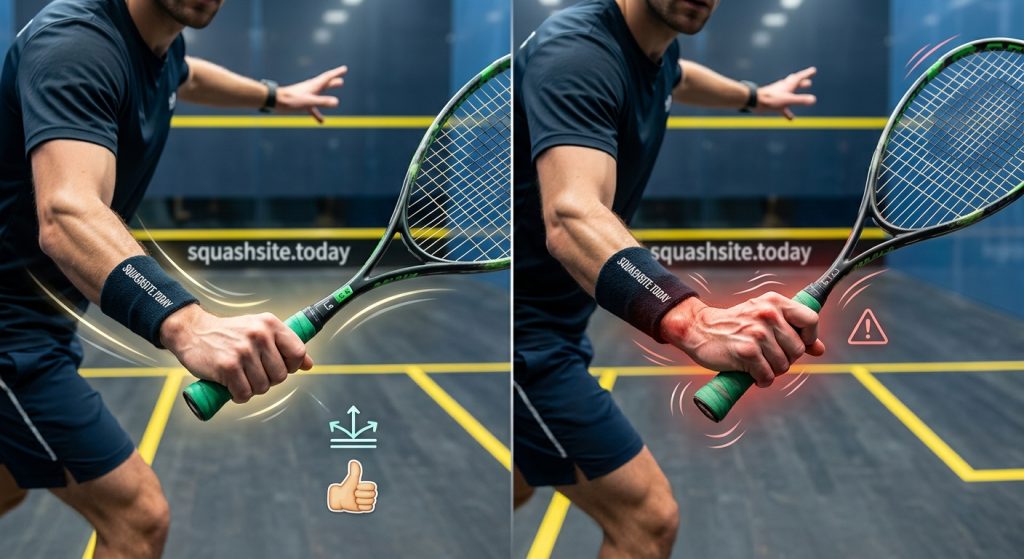
You’ve spent hours perfecting the perfect squash swing: breaking down your forehand drive in 5 simple steps, but your racket still feels awkward in your hand. Your palm cramps after three games. Your shots lack consistency. The problem might not be your technique at all. It could be something far simpler: your squash racket grip size is wrong.
Squash racket grip size directly affects control, power generation and injury prevention. Most players use grips that are too large, limiting wrist mobility and causing fatigue. Measuring from your middle finger crease to your palm base gives you a starting point, but feel and playing style matter more than any formula. Test different sizes and adjust with overgrips to find your optimal fit.
Why Grip Size Changes Everything
Your grip is the only contact point between you and the racket. Get it wrong and every other aspect of your game suffers.
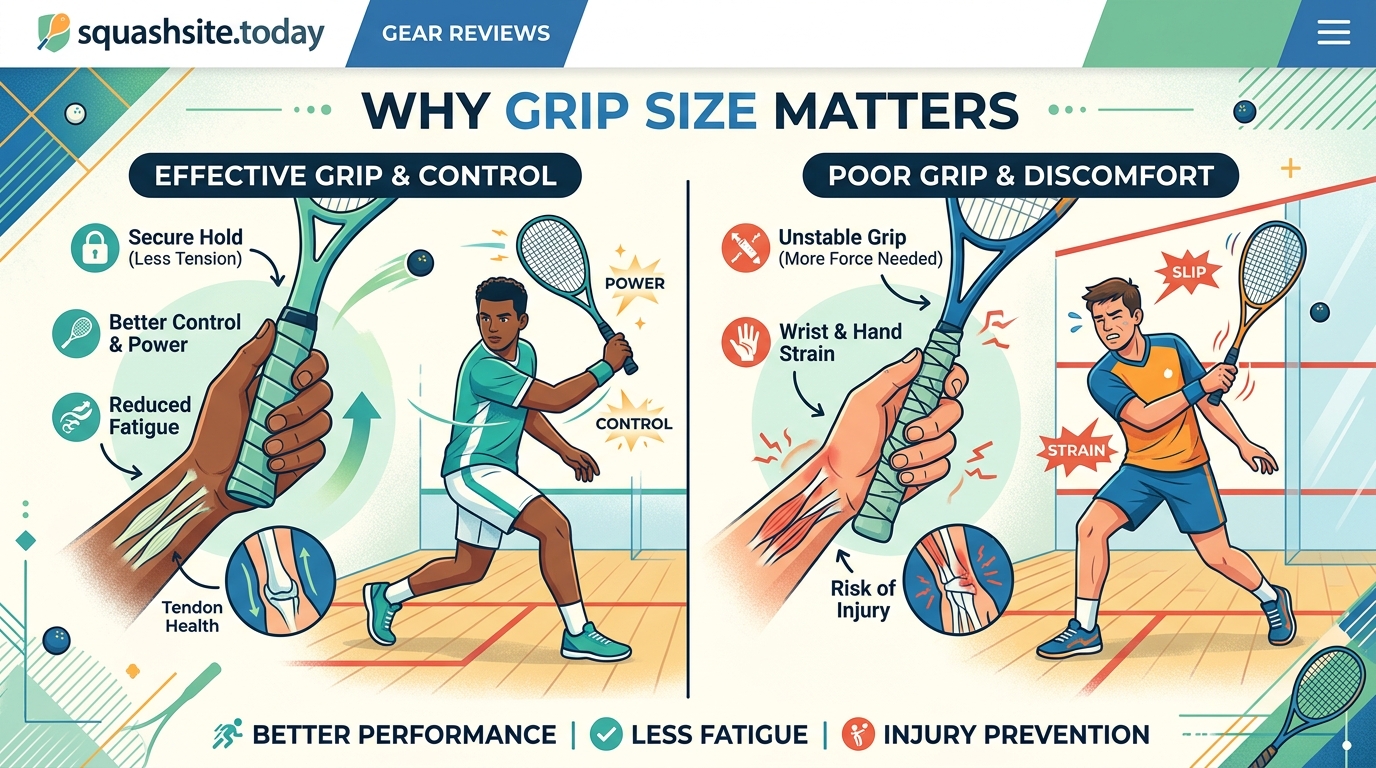
A grip that’s too large forces you to squeeze harder to maintain control. Your forearm muscles tire faster. Your wrist loses mobility. Those delicate drop shots that require touch and feel become impossible to execute consistently.
A grip that’s too small creates different problems. Your hand slides during impact. You overcompensate by gripping tighter. Blisters form. Your hand rotates inside the grip during play, throwing off your racket face angle.
Professional players obsess over grip size for good reason. A few millimetres make the difference between effortless racket control and constant adjustment.
How Squash Racket Grip Size Actually Works
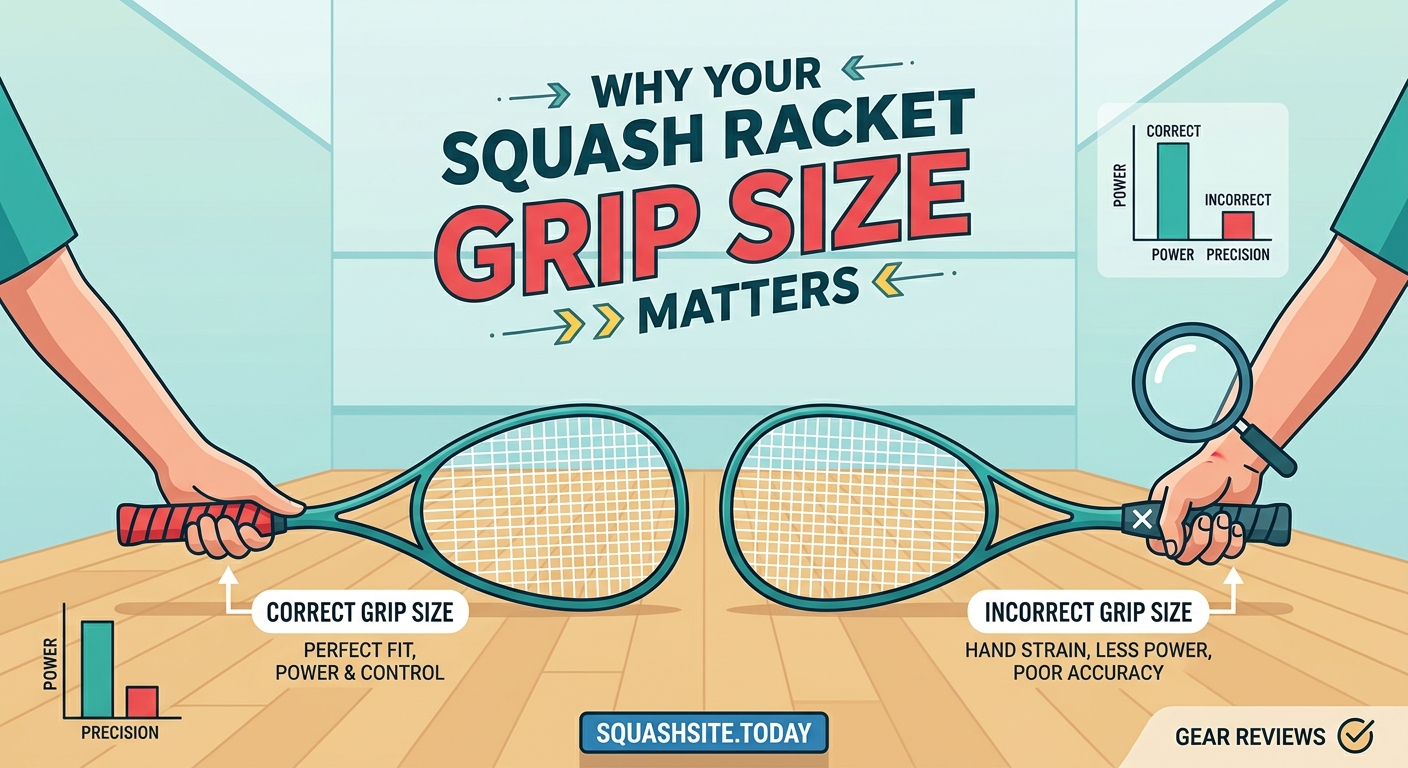
Squash grips are measured in inches around the circumference of the handle. Standard sizes range from 3.625 inches (extra small) to 4.125 inches (large).
Here’s the typical breakdown:
- Extra Small: 3.625 inches
- Small: 3.750 inches
- Medium: 3.875 inches
- Large: 4.000 inches
- Extra Large: 4.125 inches
Most manufacturers label these differently. Some use European sizing. Others just print small, medium or large. The actual measurement matters more than the label.
Unlike tennis, where larger grips are common, squash players typically use smaller sizes. The game demands more wrist action. You need to change grip styles rapidly. A smaller grip facilitates this movement.
The Traditional Measurement Method
You’ve probably heard the standard measurement technique. Hold your hand flat with fingers extended together. Measure from the middle crease of your middle finger down to the bottom horizontal crease of your palm.
This gives you a starting point in inches:
- Place a ruler at the tip of your ring finger
- Measure down to the base of your palm
- Note the measurement in inches
- This corresponds roughly to your grip size
For most adults, this measurement falls between 3.5 and 4.25 inches.
But here’s the truth: this method is just a guideline. Your actual ideal grip size depends on playing style, hand shape and personal preference.
Testing Your Current Grip Size
Before you change anything, assess what you’re currently using.
Hold your racket in your normal forehand grip. Your thumb and middle finger should nearly touch around the handle. If they overlap significantly, your grip is too small. If there’s a large gap, it’s too large.
Now check your grip pressure. Swing gently. You should maintain control without squeezing hard. If you’re white-knuckling the handle, something’s wrong.
Pay attention during your next match. Does your hand cramp? Do you develop hot spots or blisters in the same place repeatedly? Does the racket twist in your hand on off-centre hits?
These symptoms point to grip size issues.
What Happens When Your Grip Is Too Large
A grip that’s even slightly too large creates cascading problems.
Your fingers can’t wrap around properly. You compensate by squeezing harder. Forearm fatigue sets in earlier. Your touch shots suffer because you can’t relax your grip enough.
Wrist mobility decreases. The racket becomes an extension of your forearm rather than your hand. You lose the ability to generate racket head speed through wrist snap. Power comes only from your arm and shoulder.
Building an unstoppable cross-court drive requires subtle wrist adjustments. A too-large grip makes these adjustments feel clunky and forced.
Many players who struggle with backhand volleys hitting the tin are actually fighting against an oversized grip that prevents proper wrist extension.
What Happens When Your Grip Is Too Small
A too-small grip creates different but equally serious issues.
The racket rotates in your hand during impact. You constantly readjust between shots. Blisters form where your hand slides against the grip material.
You overgrip to compensate. This tension travels up your arm. Tennis elbow and wrist strain become common.
Small grips also reduce power transfer. The handle moves inside your palm on impact rather than transmitting force directly to the ball.
Finding Your Optimal Squash Racket Grip Size
Start with the measurement method to get in the ballpark. Then test.
Borrow rackets from clubmates. Most players have old rackets with different grip sizes lying around. Hit for 20 minutes with each size. Pay attention to how your hand feels, not just during play but afterwards.
The right grip should feel like a natural extension of your hand. You maintain control with moderate pressure. Your wrist moves freely. No hot spots develop after extended play.
“I went down half a size after 15 years of playing. My wrist mobility improved immediately. Suddenly I could generate more racket head speed with less effort. The difference in my drop shots was remarkable.” – Club coach with 20 years’ experience
How Playing Style Affects Grip Size Choice
Aggressive players who hit hard often prefer slightly larger grips. The extra circumference provides stability on powerful shots. It reduces the risk of the racket twisting on mishits.
Touch players typically choose smaller grips. They need maximum wrist flexibility for delicate shots. Control comes from finesse rather than power.
All-court players often land somewhere in the middle. They balance power and touch, so their grip size reflects this compromise.
Consider your game honestly. If you rely on ghosting routines to improve court movement and quick hands, a smaller grip helps. If you’re studying Paul Coll’s unorthodox power style, you might benefit from a larger grip for stability.
The Role of Overgrips in Sizing
Overgrips are your secret weapon for fine-tuning grip size.
Each overgrip adds approximately 1/16 inch to the circumference. You can build up a small grip incrementally until it feels perfect.
This approach offers flexibility. Add an overgrip before a match if your hands are sweating more than usual. Remove it if the grip feels too large.
Many professional players use a smaller base grip with multiple overgrips. They replace the overgrip frequently to maintain consistent tackiness and size.
Here’s a practical approach:
- Start with a grip one size smaller than your measurement
- Add one overgrip and test for several sessions
- Add a second overgrip if needed
- Fine-tune based on feel and performance
This method is cheaper than buying new rackets to test different sizes.
Common Grip Size Mistakes Players Make
| Mistake | Why It Happens | The Fix |
|---|---|---|
| Using the same size as tennis | Tennis requires different wrist mechanics | Measure specifically for squash, usually go smaller |
| Never questioning factory grip | Assuming manufacturers know your needs | Test different sizes regardless of stock setup |
| Ignoring grip wear | Old grips compress and effectively shrink | Replace grips every 3-6 months depending on play frequency |
| Choosing based on hand size alone | Playing style matters as much as anatomy | Consider your shot selection and power vs. touch ratio |
| Adding too many overgrips | Trying to save money on replacement grips | Use maximum two overgrips, then replace base grip |
How to Change Your Grip Size
If you’ve determined your current grip is wrong, make the change gradually.
Don’t switch sizes the day before a tournament. Your muscle memory is calibrated to your current setup. Give yourself at least three weeks to adjust.
Start by using the new size during practice sessions only. Keep your old racket for matches initially. As the new size feels more natural, transition it into competitive play.
Your shot accuracy will dip temporarily. This is normal. Your brain is recalibrating the feel and feedback from your hand.
Some specific adjustments you’ll notice:
- First week: Everything feels strange. Resist the urge to go back.
- Second week: Basic shots feel more natural. Complex shots still feel off.
- Third week: Your touch returns. Power and control start improving.
- Fourth week: The new size feels normal. Performance typically exceeds your old baseline.
Grip Size and Injury Prevention
Incorrect grip size is a major contributor to squash-related injuries.
Tennis elbow (lateral epicondylitis) often stems from overgripping. When your grip is too large or too small, you compensate by squeezing harder. This constant tension inflames the tendons in your elbow.
Wrist strain follows similar patterns. An ill-fitting grip forces your wrist into compromised positions during shots. Over thousands of repetitions, this creates chronic problems.
Blisters seem minor but indicate your hand is moving against the grip. This movement means you’re losing power and control while damaging your skin.
If you’re experiencing any of these issues, assess your grip size before assuming you need time off or medical intervention.
Special Considerations for Different Hand Shapes
Hand size and hand shape are different things.
Some players have thick palms but short fingers. Others have long, thin fingers with narrow palms. The standard measurement method doesn’t account for these variations.
If you have thick palms, you might need a larger grip than the measurement suggests. Your palm needs space even if your fingers are average length.
Long, thin fingers often work better with smaller grips. You can wrap around further, giving you more control surface area.
Women typically use smaller grips than men, but plenty of women play with medium or even large grips. Don’t let assumptions about gender dictate your choice.
Junior players need special attention. Their hands grow. A grip that’s perfect today might be too small in six months. Budget for grip changes as part of their development.
Testing Grip Size During Actual Play
Measurement and static testing only tell you so much. Real play reveals the truth.
Book a court for an hour specifically to test grip size. Bring multiple rackets or be prepared to add and remove overgrips between drills.
Run through this testing sequence:
- Warm-up drives: Hit 50 forehand and backhand drives. Note any hand fatigue or discomfort.
- Volleys: Execute 30 volleys on each side. Check if the racket twists on impact.
- Drop shots: Play 20 drop shots. Assess your touch and feel.
- Power shots: Hit 20 hard drives and kills. Monitor grip security.
- Match simulation: Play points for 15 minutes. Notice any grip adjustments you make unconsciously.
Rate each grip size on control, power, comfort and confidence. The winner should be clear.
How Professional Players Approach Grip Size
Top players treat grip size as seriously as string tension.
Mohamed ElShorbagy’s training regime includes regular equipment checks. He monitors grip wear and replaces grips before they affect his game.
Many professionals use smaller grips than you’d expect for their hand size. They prioritise wrist mobility and racket head speed over grip stability.
They also customise aggressively. Some build up specific parts of the grip to create bevels that suit their hand position. Others sand down areas to reduce bulk.
You don’t need to go this far, but the principle applies: grip size is personal and performance-critical.
When to Seek Expert Advice
Most players can find their optimal grip size through testing. But sometimes expert input helps.
A qualified coach can watch your swing mechanics and identify whether grip size is limiting your technique. They spot compensations you don’t feel.
Specialty squash shops often have demo rackets in multiple grip sizes. Staff who play competitively can offer insights based on your playing style.
Physiotherapists who treat racket sport injuries understand the biomechanics. If you’re dealing with chronic hand, wrist or elbow pain, they can assess whether grip size contributes.
Don’t be shy about asking for help. Every serious player has wrestled with equipment setup at some point.
Making Peace With Your Grip Size Decision
You’ll never achieve absolute certainty. Grip size exists on a continuum. Your ideal sits in a range, not at a single precise measurement.
Some days a slightly larger grip feels better. Other days you want maximum wrist mobility. This variation is normal.
Choose a size that works well most of the time. Accept that it won’t feel perfect every session. Use overgrips to make minor adjustments when needed.
Once you’ve settled on a size, commit to it for at least three months. Constant changes prevent you from developing consistent muscle memory and touch.
Your grip size might change over time as your game evolves. A player developing more power might go up half a size. Someone adding more touch might go down. Stay open to reassessment without obsessing over it.
Your Hand Knows Best
All the measurements and guidelines in the world matter less than how your racket feels during a tough rally. Trust your hand.
If your current grip size lets you play your best squash without pain or fatigue, you’ve found your answer. If something feels off, test alternatives systematically.
The right squash racket grip size disappears during play. You stop thinking about the handle and focus entirely on the ball. That’s when you know you’ve got it right.
Start paying attention to your grip during your next session. Make one small change if needed. Your improved control and reduced fatigue will tell you whether you’re heading in the right direction.