Footwork Fundamentals: The Ladder Drill Programme That Actually Works
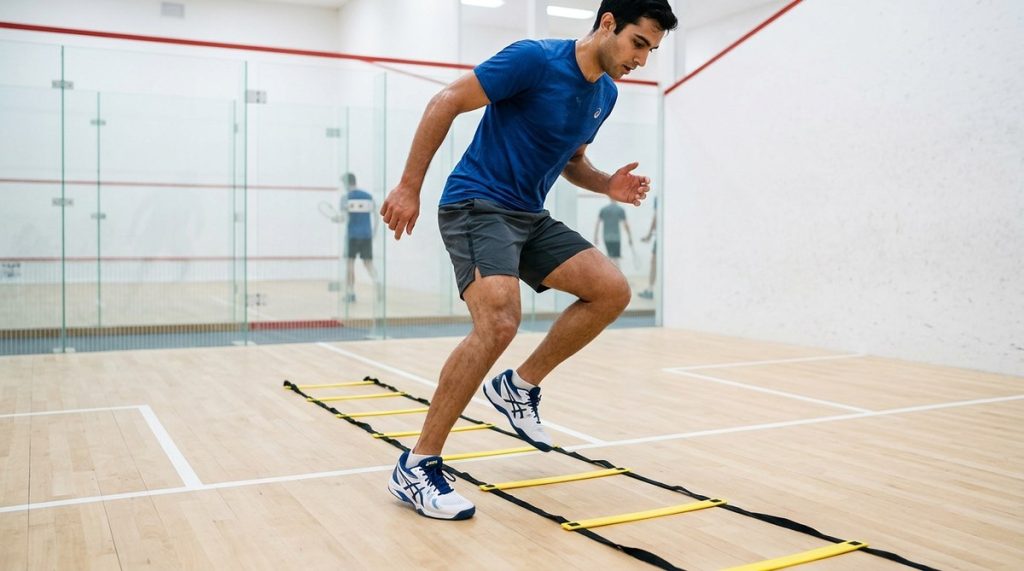
You’ve seen athletes flying through ladder drills on social media, their feet moving so fast they blur. You’ve tried a few patterns yourself, maybe felt a bit silly, and wondered if these drills actually make you faster or just look impressive on camera.
Here’s the truth: ladder drills work brilliantly when programmed correctly. They fail when you treat them like a random warm-up or a flashy party trick.
A proper ladder drill footwork routine builds neural pathways for faster foot speed, sharper directional changes, and better coordination. The key is progressive overload: master basic patterns at controlled speeds before advancing to complex combinations. Consistency matters more than intensity. Three focused 15-minute sessions weekly deliver better results than sporadic hour-long attempts. Track your progress, fix technique errors early, and apply the movement patterns to your sport-specific training.
Why Most Ladder Routines Fail Athletes
Walk into any gym and you’ll see people sprinting through ladder drills with terrible form. Their feet land heavily. Their knees cave inward. They trip constantly but keep pushing faster.
This approach builds nothing except frustration.
Ladder drills aren’t about speed initially. They’re about precision. Your nervous system needs to learn the patterns first. Only then can you add velocity without sacrificing quality.
The second mistake? No progression plan. Athletes repeat the same three drills for months, expecting different results. Your body adapts to repeated stimuli within weeks. Without new challenges, improvement stalls.
Finally, most routines ignore sport-specific transfer. Basketball players need different patterns than tennis players. Squash demands unique directional changes that generic ladder work doesn’t address. Your routine must match your movement demands.
Building Your Foundation With Core Patterns
Start with these five fundamental drills. Master them before attempting fancy combinations.
Single-Step Run
Place one foot in each square, running the length of the ladder. Sounds simple. Most people still get it wrong.
Land on the balls of your feet. Keep your chest up. Drive your knees forward, not upward. Your feet should kiss the ground and bounce off immediately. No stomping.
Practice this for two weeks before moving on. Seriously. Your ankle stability and foot-ground contact time will improve dramatically.
Two Feet In
Step both feet into each square before advancing. This drill teaches you to gather your feet quickly, essential for changing direction in any sport.
Common error: stepping too wide. Your feet should land hip-width apart, ready to explode in any direction. Too wide and you’re stuck. Too narrow and you’re unstable.
Lateral Shuffle
Face sideways to the ladder. Step your lead foot into the first square, follow with your trailing foot, then step out with your lead foot. Repeat down the ladder.
This mirrors the defensive shuffle in basketball, the split-step recovery in tennis, and the T-position movement in squash. The pattern translates directly to court sports.
Keep your hips low. Don’t bounce vertically. Slide your feet across the ground like you’re skating on ice.
Ickey Shuffle
Step in with your right foot, follow with your left, step out with your right. Next square: left foot in, right foot follows, left foot out.
This drill confuses people initially. That’s the point. Your brain has to work harder to coordinate the pattern. Once it clicks, your feet respond faster to complex movement demands.
Crossover Step
Step your right foot into the first square, cross your left foot over in front, step your right foot into the next square outside the ladder, then bring your left foot into that square.
This teaches hip rotation and crossing patterns used in every change-of-direction sport. Football players use it cutting upfield. Tennis players use it recovering to centre court.
Your 12-Week Progressive Routine
Follow this structured plan to build genuine speed improvements.
Weeks 1-2: Pattern Mastery
Perform each drill at 50% speed. Focus entirely on technique.
- Single-step run: 3 sets of 2 lengths
- Two feet in: 3 sets of 2 lengths
- Lateral shuffle (both directions): 2 sets of 2 lengths each side
- Rest 60 seconds between sets
Total time: 12 minutes. Do this three times weekly with at least one rest day between sessions.
Film yourself. Watch the footage. Your perception of your movement rarely matches reality. Fix errors now before they become habits.
Weeks 3-4: Speed Introduction
Increase to 70% speed. Your form should remain clean.
- Single-step run: 2 sets of 2 lengths
- Two feet in: 2 sets of 2 lengths
- Lateral shuffle: 2 sets of 2 lengths each side
- Ickey shuffle: 3 sets of 2 lengths
- Rest 45 seconds between sets
Total time: 15 minutes. Maintain your three-sessions-weekly schedule.
Add one set of each drill at maximum speed with perfect form. If your technique breaks down, you’re not ready. Drop back to 70% speed.
Weeks 5-8: Complexity Building
Introduce combination drills and directional changes.
- Single-step run + immediate 180-degree turn + sprint back: 3 sets
- Ickey shuffle + crossover step: 3 sets
- Lateral shuffle right + lateral shuffle left (no pause): 3 sets
- Two feet in + single-leg hops (alternate legs each square): 3 sets
- Rest 60 seconds between sets
Total time: 18 minutes. Your body needs more recovery as intensity increases.
Weeks 9-12: Sport-Specific Application
Design patterns that mirror your sport. For squash players, this means incorporating the movement patterns you use during ghosting routines that actually improve your court movement.
Create custom combinations:
- Ladder drill + sport-specific movement (example: ladder work + forehand drive simulation)
- Reactive drills (partner calls out patterns mid-drill)
- Fatigue drills (perform ladder work after conditioning)
Common Mistakes That Kill Your Progress
| Mistake | Why It Happens | How to Fix |
|---|---|---|
| Looking down constantly | Lack of pattern familiarity | Practice without the ladder using tape on the ground |
| Heavy foot contacts | Weak ankles and calves | Add calf raises and ankle mobility work |
| Upper body tension | Trying too hard | Relax your shoulders, keep hands loose |
| Inconsistent rhythm | Poor motor control | Use a metronome app to establish timing |
| Skipping rest periods | Impatience | Set a timer, respect recovery |
The biggest error? Training ladder drills in isolation. These patterns must transfer to your sport. Spend equal time applying the improved footwork to actual game situations.
After your ladder session, immediately practice sport-specific movements. If you play tennis, hit volleys. Basketball players should do defensive slides. Squash players should work on footwork mistakes on the T that ladder drills help correct.
Equipment and Space Requirements
You need surprisingly little to start.
The ladder: A standard agility ladder measures 15 feet long with 12-inch squares. Flat rungs work better than round ones. They lie flatter and don’t roll.
Budget option? Use chalk, tape, or cones to create your own grid. Spacing matters more than fancy equipment.
Footwear: Wear the shoes you compete in. Training in running shoes then playing in court shoes defeats the purpose. Your feet need to learn the patterns in game-appropriate footwear.
Space: A 20-foot strip of flat ground. Grass, court surface, or gym floor all work. Avoid concrete if possible. Your joints will thank you after hundreds of repetitions.
Optional additions: A timer or stopwatch helps track rest periods. A small mirror or phone camera provides instant feedback on form.
Programming Ladder Work Into Your Training Week
Ladder drills fit best early in your training session when your nervous system is fresh.
Monday: Ladder routine (15 minutes) + sport-specific skill work
Wednesday: Ladder routine (15 minutes) + conditioning
Friday: Ladder routine (15 minutes) + competitive play
Never perform complex ladder patterns when fatigued. Tired athletes develop poor movement habits. Save conditioning work for after your footwork training.
Rest days matter. Your nervous system adapts during recovery, not during the drill itself. Overtraining footwork leads to diminishing returns and potential injury.
Measuring Your Improvement
Track these metrics every four weeks:
- Time to complete standard patterns (single-step run, two feet in, lateral shuffle)
- Number of foot contacts outside the ladder per length
- Maximum speed while maintaining perfect form
- Ability to perform patterns without looking down
Create a simple spreadsheet. Record your times. Watch the numbers improve. This objective data keeps you motivated when progress feels slow.
“The athletes who improve fastest aren’t the ones with the best natural speed. They’re the ones who track their progress, identify weaknesses, and address them systematically. Footwork development is a science, not a guessing game.”
Beyond numbers, assess how the training transfers to your sport. Are you reaching balls you previously couldn’t? Can you change direction faster? Do you feel more stable during explosive movements?
These real-world improvements matter more than ladder times. The drills are tools, not the goal itself.
Advanced Variations for Experienced Athletes
Once you’ve mastered the foundation, try these challenging progressions.
Single-leg patterns: Perform any drill hopping on one leg. This builds tremendous ankle stability and unilateral strength. Start slowly. These patterns are brutally difficult.
Backwards patterns: Run drills in reverse. Your brain has to work harder. Your posterior chain activates differently. The coordination challenge is significant.
Resistance patterns: Wear a weighted vest or resistance bands. The added load forces your muscles to generate more force. Use light resistance only (5-10% of body weight).
Reaction drills: Have a partner call out patterns mid-drill. You must switch instantly. This mirrors the reactive demands of actual competition.
Vision restriction: Perform familiar patterns with your eyes closed or looking straight ahead. This forces your feet to learn the spacing without visual input.
These variations should supplement, not replace, your core routine. Spend 80% of your time on fundamental patterns and 20% on advanced work.
Connecting Footwork to Overall Athletic Development
Ladder drills alone won’t transform you into an elite athlete. They’re one piece of a larger puzzle.
Combine your footwork training with strength work. Strong legs move faster. Protecting your knees whilst reaching every ball requires both agility and strength.
Add plyometric training. Box jumps, broad jumps, and depth jumps develop the explosive power that makes your improved footwork patterns actually fast.
Don’t neglect mobility. Tight hips and ankles limit your movement quality regardless of how many ladder drills you perform. Spend 10 minutes daily on hip flexor stretches, ankle circles, and dynamic leg swings.
The best athletes integrate multiple training modalities. Ladder work improves coordination. Strength training builds force production. Plyometrics develop power. Mobility work ensures full range of motion. Together, they create complete athletic development.
Troubleshooting Common Frustrations
“I keep tripping over the rungs”
Slow down. You’re moving faster than your current skill level allows. Drop to 50% speed and rebuild from there. Tripping indicates your brain hasn’t fully learned the pattern yet.
“My calves are burning after 30 seconds”
Your lower legs lack endurance. This improves with consistent training. In the meantime, take longer rest periods and perform fewer sets. Build volume gradually over weeks.
“I don’t feel faster in my sport”
You’re not applying the patterns. Ladder drills teach your feet to move. You must consciously transfer that skill to game situations. After every ladder session, immediately practice sport-specific movements using the same foot patterns.
“Progress has stalled”
You’ve adapted to your current routine. Change the stimulus. Add new patterns, increase speed, reduce rest periods, or incorporate resistance. Your body needs novel challenges to improve.
Making Ladder Training Stick Long-Term
The athletes who gain the most from ladder drills are the ones who stick with them for months, not weeks.
Build the routine into your schedule like brushing your teeth. Same days, same time, same commitment. Motivation fades. Habits persist.
Find a training partner. Accountability keeps you consistent when enthusiasm wanes. Plus, you can run reactive drills together and push each other’s intensity.
Celebrate small wins. Shaved half a second off your single-step run? That’s progress. Completed a complex pattern without looking down? Mark it. These micro-improvements compound into major gains.
Remember why you started. Faster feet mean better performance in your sport. Every ladder session moves you closer to that goal.
Why This Routine Delivers Results
This programme works because it respects how your body actually learns movement patterns.
You start slowly, building neural pathways before demanding speed. You progress systematically, adding complexity only after mastering foundations. You train consistently, allowing adaptations to occur. You measure progress, ensuring you’re moving forward, not just moving.
Most importantly, you connect the drills to your sport. Ladder work isn’t the destination. It’s preparation for better performance when it counts.
Your feet are your foundation in any athletic movement. Train them properly and everything else improves. Neglect them and you’ll always be a step behind.
The ladder is waiting. Your improved footwork starts with the first deliberate step into that first square. Make it count.