Pre-Match Warm-Up Routines From the PSA Tour
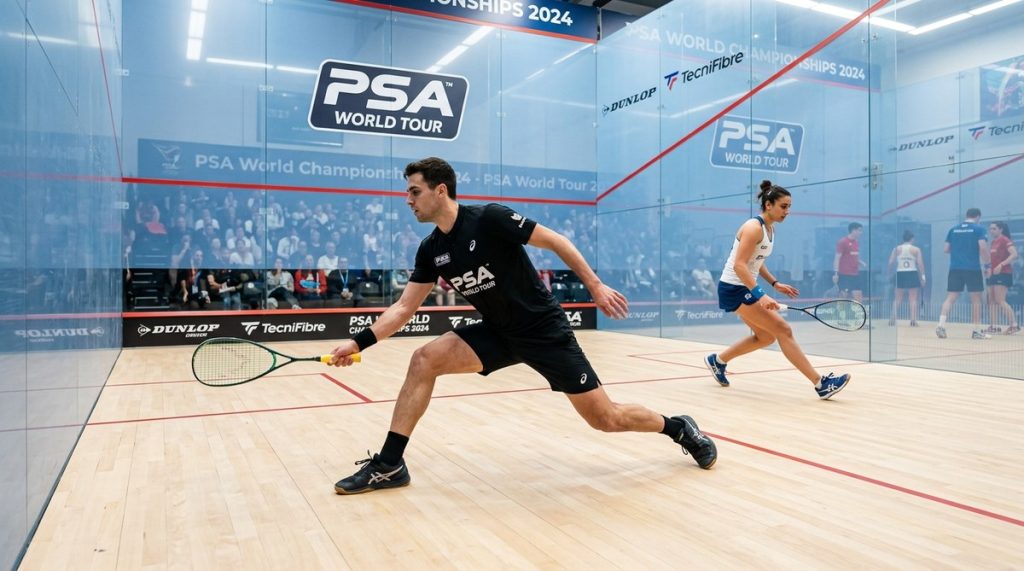
Walking onto court cold is the fastest way to lose the first game before you’ve even started competing. Professional players on the PSA Tour understand that the warm up isn’t just about preventing injury. It’s about priming your body for explosive movement, calibrating your touch, and mentally preparing for battle.
The difference between a rushed five-minute knockabout and a structured professional squash warm up routine can determine whether you control the pace from the first point or spend three games trying to find your rhythm.
Professional players follow a systematic 15 to 20-minute warm up sequence that activates specific muscle groups, rehearses shot patterns, and establishes court feel. This routine combines dynamic stretching, controlled movement drills, progressive shot practice, and tactical observation. Adopting this structure helps intermediate and advanced players reduce injury risk, improve first-game performance, and gain psychological confidence before competitive matches.
Why Professional Players Never Skip Their Pre-Match Routine
The PSA Tour operates at a level where margins are razor-thin. A single cold muscle or mistimed volley can shift momentum permanently.
Professional players treat the warm up as sacred time. They arrive at the venue 45 to 60 minutes before match time, allowing for changing, mental preparation, and the physical routine itself.
This isn’t superstition. Research shows that properly warmed muscles contract more efficiently and respond faster to directional changes. Your first lunge to the front corner shouldn’t be the one that tests whether your hamstring is ready.
Top players also use this window to assess court conditions. Temperature, humidity, and ball bounce all vary between venues. A few minutes hitting allows you to adjust your shot selection before the score matters.
The Four-Phase Structure of a Professional Warm Up
PSA players don’t randomly hit balls until the referee calls time. They follow a deliberate progression that builds intensity and specificity.
Phase One: Dynamic Preparation Off Court
This takes 5 to 8 minutes and happens in the changing room or warm up area.
The focus is controlled movement that raises heart rate and activates the posterior chain, hip flexors, and rotational muscles used in squash.
Common exercises include:
- Walking lunges with torso rotation
- Leg swings (forward, lateral)
- Arm circles and shoulder rotations
- High knees and heel flicks
- Lateral shuffles with resistance bands
- Controlled squats with reach
Players avoid static stretching at this stage. Holding stretches for 30 seconds can temporarily reduce power output. Save that for post-match recovery.
Phase Two: Court Familiarisation and Movement Activation
Once on court, professionals spend 3 to 5 minutes moving without the ball.
This phase establishes spatial awareness and wakes up the neuromuscular patterns specific to squash movement.
Typical drills include:
- Ghosting routines that actually improve your court movement to each corner
- Short sprints from T to front wall and back
- Lateral movement along the front wall
- Figure-eight patterns around the service boxes
- Shadow swings in each corner
Players focus on explosive first steps and controlled recovery to the T. The goal is to feel balanced and responsive before adding the complexity of hitting.
Phase Three: Progressive Shot Practice
This is the core of the warm up, lasting 8 to 12 minutes.
Professionals follow a specific sequence that builds from simple to complex, slow to fast.
-
Controlled drives down the wall (2 minutes per side): Both players hit straight drives at medium pace. This establishes length, rhythm, and racket preparation. Players focus on clean contact and consistent depth.
-
Cross-court drives (2 minutes): Switching to diagonal patterns tests rotation and timing. Good players use this to groove building an unstoppable cross-court drive with proper width.
-
Volleys (2 to 3 minutes): Starting at mid-court, players exchange volleys. This sharpens reflexes and hand-eye coordination. The pace gradually increases. Many players specifically rehearse why your backhand volley keeps hitting the tin scenarios during this window.
-
Short game (2 to 3 minutes): Drops, boasts, and kills from the front. This calibrates touch and tests movement to the front corners. Players use the drop shot masterclass principles to ensure clean execution.
-
Service practice (1 to 2 minutes): Each player hits 6 to 10 serves from both boxes. This isn’t just about warming up the serve. It’s about claiming psychological ownership of the space.
Phase Four: Match-Pace Simulation
The final 2 to 3 minutes involve hitting at match intensity.
Players exchange attacking shots, test retrieval from deep positions, and hit with full power. This bridges the gap between practice and competition.
Some professionals finish with a few rallies that mimic actual match patterns. Others prefer to end on a confident winner rather than risk a mistake before the real scoring begins.
What Separates Professional Preparation From Amateur Routines
The table below highlights the differences between how most club players warm up versus how PSA Tour professionals approach pre-match preparation.
| Aspect | Amateur Approach | Professional Approach |
|---|---|---|
| Timing | Arrive 10 minutes early, rush onto court | Arrive 45-60 minutes early for complete routine |
| Off-court work | Skip entirely or do static stretches | 5-8 minutes dynamic activation exercises |
| Shot sequence | Random hitting with no structure | Deliberate progression from simple to complex |
| Intensity | Start hitting hard immediately | Gradual build from 60% to 100% pace |
| Mental focus | Chat with opponent, unfocused | Observe opponent’s patterns, visualise tactics |
| Duration | 5 minutes total | 15-20 minutes on-court minimum |
The professional approach treats the warm up as the first opportunity to gain advantage. Every minute has purpose.
How to Observe Your Opponent During the Warm Up
Top players use the warm up as reconnaissance.
They’re not just hitting. They’re gathering intelligence about weaknesses, preferred patterns, and physical condition.
“I watch how my opponent moves to the front corners during the warm up. If they’re tentative on the forehand side or slow to recover from deep lunges, I know where to attack in the first game.” — PSA Top 20 player
Specific observations include:
- Which corner they struggle to reach comfortably
- Whether they favour forehand or backhand volleys
- How they handle pace (do they rush or stay composed?)
- Their preferred serve type and return position
- Signs of injury or restricted movement
This information shapes your tactical approach before the first point.
You’re also sending signals to your opponent. Hitting crisp winners and moving fluidly can create doubt in their mind. Conversely, showing weakness invites aggression.
The warm up is psychological warfare disguised as cooperation.
Common Warm Up Mistakes That Cost You the First Game
Even experienced players make errors that sabotage their preparation.
Starting too intensely: Hitting winners from the first ball might feel impressive, but it doesn’t properly prepare your body. You need gradual progression to avoid injury and establish consistency.
Neglecting movement preparation: Spending the entire warm up stationary at mid-court means your first lunge in the match is also your first explosive movement. That’s when muscles tear.
Ignoring the short game: Many players hit drives and volleys but skip drops and boasts. Then they’re surprised when their touch feels off during crucial points.
Poor time management: Arriving late forces you to rush. Professionals build buffer time into their schedule to account for traffic, court delays, or equipment issues.
Forgetting to test court conditions: Ball bounce, temperature, and floor grip vary. Hit a few shots to each corner to understand how the ball behaves before the score matters.
Failing to establish a routine: Consistency breeds confidence. Having the same warm up sequence for every match creates mental anchors that help you feel prepared.
Adapting the Professional Routine to Your Match Schedule
Not every match allows 20 minutes of court time. League nights often restrict warm ups to 5 minutes.
The key is prioritising the most important elements.
If you have only 5 minutes, follow this condensed sequence:
- 90 seconds: Straight drives (45 seconds per side)
- 90 seconds: Volleys at mid-court
- 90 seconds: Short game (drops and boasts)
- 60 seconds: Match-pace hitting and serves
This abbreviated version still covers the essential shot types and movement patterns.
Do your dynamic stretching and movement activation off court before you step on. Use the changing room, corridor, or car park. Those exercises don’t require a court.
For tournament matches with full warm up time, extend each phase. Spend extra time on your weaker shots. If your backhand drive lacks consistency, allocate an additional minute to grove the perfect squash swing on that side.
Building Your Personal Pre-Match Checklist
Professional players often use written or mental checklists to ensure nothing gets missed.
Creating your own checklist helps maintain consistency across different venues and stress levels.
Your checklist might include:
- Arrive 45 minutes before match time
- Complete off-court dynamic warm up (8 minutes)
- Check equipment (racket, shoes, spare strings, towel, water)
- Mental visualisation of game plan (3 minutes)
- Court movement drills (4 minutes)
- Shot progression sequence (10 minutes)
- Final mental reset and breathing exercises (2 minutes)
Having this written down removes decision-making when you’re nervous. You simply execute the list.
Many players also include post-warm up habits, such as changing shirts if sweaty, retying shoes, or taking a specific number of deep breaths before walking onto court for the match.
These rituals aren’t superstition. They’re psychological anchors that signal to your brain that you’re ready to compete.
The Mental Component of Physical Preparation
The warm up isn’t purely physical. It’s when you transition from everyday life to competitor mode.
Professional players use specific mental techniques during the warm up to sharpen focus and manage pre-match nerves.
Breathing control: Between shot sequences, take deliberate breaths. Inhale for four counts, hold for four, exhale for six. This activates the parasympathetic nervous system and reduces anxiety.
Positive self-talk: Reinforce confidence with internal dialogue. “My movement feels sharp.” “I’m seeing the ball clearly.” This primes your brain for success rather than dwelling on potential mistakes.
Tactical visualisation: Between hitting sessions, visualise specific patterns you’ll use. See yourself executing a tight straight drive followed by a cross-court nick. Mental rehearsal strengthens neural pathways.
Anchoring to past success: Recall a match where you performed well. Remember how your body felt, how you moved, how confident you were. Bring that feeling into the present.
These techniques work best when practised regularly. Don’t try a new mental routine for the first time before a crucial match.
How Equipment Choices Impact Your Warm Up
What you wear and use during the warm up matters more than most players realise.
Footwear: Always warm up in the shoes you’ll wear for the match. Different shoes have different grip patterns and cushioning. Your movement patterns need to calibrate to the specific footwear. Learn more about should you switch to non-marking gum sole or stick with traditional squash shoes.
Racket: Use your primary racket, not a backup. String tension, balance, and grip size all affect how you hit. If you’re testing the truth about squash string tension, do it during practice, not before a match.
Clothing layers: Start with an extra layer if the venue is cold. Remove it gradually as you warm up. Muscles perform better at optimal temperature.
Grip: If you use an overgrip, apply a fresh one before the warm up. A worn grip affects your hold and can cause blisters during the match.
Eye protection: If you wear goggles, put them on during the warm up. This ensures they’re positioned correctly and won’t fog up. Check out the complete guide to choosing squash goggles for more details.
Tracking Your Warm Up Effectiveness Over Time
The best way to improve your pre-match routine is to measure its impact.
After each match, note how you felt during the first game:
- Did your movement feel sharp from the first point?
- Were your shots landing where intended?
- Did you feel physically and mentally ready?
- How long did it take to settle into your rhythm?
If you consistently struggle in first games despite warming up, your routine needs adjustment.
Perhaps you’re not allocating enough time to movement drills. Maybe you need more short game practice. Or you might be starting too intensely and tiring yourself before the match begins.
Keep a simple log in your phone or training journal. Over time, patterns emerge that guide refinement.
Professional players constantly tweak their routines based on performance data and physical feedback. Your warm up should be a living process, not a fixed ritual.
When to Modify Your Routine Based on Match Timing
Morning matches require different preparation than evening ones.
Your body temperature, energy levels, and mental alertness vary throughout the day.
Early morning matches (before 10am): Extend your dynamic warm up by 2 to 3 minutes. Your muscles are stiffer after sleep. Include extra hip rotations and leg swings. Consider a light jog or skipping rope before arriving at the venue.
Midday matches: Standard routine works well. Your body is naturally warmed from daily activity.
Evening matches (after 6pm): You’ve been active all day, so muscles are warm. Focus more on mental preparation and shot calibration. You might reduce the off-court dynamic work slightly.
Back-to-back matches (tournaments): Between matches, maintain body temperature with light movement. Don’t let muscles cool completely. A 5-minute reactivation routine before the second match prevents stiffness.
Learning From the Best on the PSA Tour
Watching professional players warm up offers valuable lessons.
At PSA tournaments, arrive early and observe how top players prepare. Notice their movement patterns, shot sequences, and intensity progression.
Many professionals share their routines on social media or in coaching content. Study these resources to understand the principles behind their choices.
Different players have different styles. Some prefer longer warm ups with extensive movement work. Others focus more on shot rehearsal. Find approaches that match your physical needs and playing style.
The key isn’t copying a specific player’s routine exactly. It’s understanding the principles (progressive intensity, comprehensive shot coverage, mental preparation) and adapting them to your context.
You can also learn from 5 match-winning tactics used by top 10 PSA players that you can master during your warm up observation.
Turning Warm Up Time Into Competitive Advantage
The players who treat pre-match preparation as seriously as the match itself consistently perform better in opening games.
They’re not hoping to find their rhythm. They’ve already established it.
Their bodies are primed for explosive movement. Their shots are calibrated to court conditions. Their minds are focused and confident.
This doesn’t happen by accident. It’s the result of deliberate, structured preparation.
Start treating your warm up as the first opportunity to win, not just a formality before the real competition begins. Arrive early. Follow a systematic routine. Observe your opponent. Prime your body and mind.
The professional squash warm up routine isn’t complicated, but it requires discipline and consistency. Implement these principles before your next match and notice how differently the first game feels when you’re genuinely ready to compete from the opening point.