What Makes a Great Squash Coach? 7 Essential Qualities Beyond Technical Knowledge
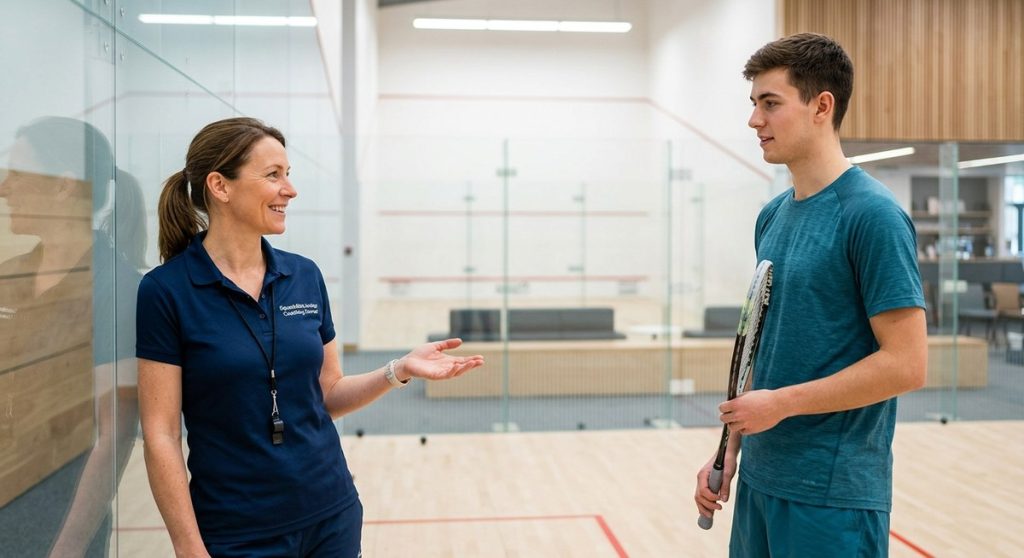
Choosing the right squash coach can transform a player’s relationship with the sport. Technical knowledge matters, but it’s only part of the equation. The best coaches possess a unique combination of interpersonal skills, adaptability, and genuine passion that creates an environment where players thrive both on and off the court.
Exceptional squash coaches combine communication excellence, emotional intelligence, and individualised teaching approaches with technical expertise. They adapt their methods to each player’s learning style, maintain professional standards through continuous development, and foster genuine enthusiasm for the sport. These qualities create lasting player development and cultivate a lifelong love of squash beyond simple stroke mechanics.
Communication That Actually Connects
A coach might understand every nuance of the perfect squash swing, but that knowledge becomes worthless if they cannot convey it clearly.
Great coaches translate complex movements into simple, actionable instructions. They avoid jargon when teaching beginners and know exactly when to introduce more sophisticated terminology.
Watch how a coach explains corrections during a lesson. Do they demonstrate physically? Do they use analogies that resonate with the player’s experience? Do they check for understanding rather than simply moving on?
The best instructors adjust their communication style based on who’s standing in front of them. A visual learner needs demonstrations. An analytical player responds to technical breakdowns. A young junior might need playful imagery to grasp a concept.
Reading the Room
Effective coaches notice when a player’s eyes glaze over. They recognise frustration before it boils over. They sense when someone needs encouragement versus when they need a gentle push.
This awareness extends to non-verbal communication too. Body language, tone of voice, and energy levels all send messages. A coach who crosses their arms and sighs when a student makes a mistake creates a very different learning environment than one who maintains open, encouraging posture.
Patience That Withstands Repetition
Teaching the same fundamental movement for the hundredth time requires extraordinary patience. Yet this quality separates good coaches from exceptional ones.
Players learn at different speeds. Some grasp footwork corrections immediately. Others need weeks of repetition before the movement becomes natural.
A quality coach never makes a student feel inadequate for needing extra time. They find new ways to explain the same concept. They celebrate tiny improvements that others might miss.
“The mark of a truly patient coach isn’t just tolerating slow progress. It’s genuinely believing that every player can improve, regardless of how long it takes.” – David Palmer, former World No. 1
Consider how a coach responds when a player repeatedly makes the same error. Do they show visible irritation? Do they blame the student? Or do they calmly reassess their teaching approach and try a different method?
Individualised Teaching Approaches
Cookie-cutter coaching programmes rarely produce exceptional results. Players come with different physical abilities, learning preferences, mental approaches, and goals.
An outstanding coach develops personalised training plans that account for these variables. They might teach two players the same cross-court drive technique, but the path to mastery looks completely different for each person.
Assessing Individual Needs
The evaluation process should happen continuously, not just during an initial assessment. Great coaches constantly observe, question, and adjust their approach based on what they’re seeing.
Here’s how effective coaches tailor their teaching:
- Conduct a thorough initial assessment covering technical skills, fitness level, tactical understanding, and personal goals
- Identify the player’s primary learning style through observation and direct questions
- Design a programme that addresses specific weaknesses whilst building on existing strengths
- Monitor progress through regular check-ins and adjust the plan as needed
- Incorporate the player’s feedback into ongoing programme modifications
This systematic approach ensures no player falls through the cracks or gets pushed into a training model that doesn’t suit them.
Emotional Intelligence and Empathy
Technical expertise means nothing if a coach cannot connect with their students on a human level. The ability to understand and respond to emotions makes the difference between a player who quits after six months and one who plays for life.
Coaches with high emotional intelligence recognise when a player is struggling with confidence, dealing with external stress, or losing motivation. They adjust their approach accordingly.
A junior player who just performed poorly in a school exam might need a lighter, more fun session that day. An adult player going through a difficult period at work might benefit from an intense physical workout that provides mental relief.
Building Trust and Rapport
Players perform better when they trust their coach completely. This trust develops through consistent behaviour, genuine interest in the player’s wellbeing, and demonstrated competence.
Consider these trust-building behaviours:
- Arriving on time for every session without exception
- Remembering details about the player’s life outside squash
- Admitting when they don’t know something rather than bluffing
- Following through on promises and commitments
- Maintaining appropriate professional boundaries
- Protecting confidential information shared during sessions
Trust takes months to build but can be destroyed in moments. The best coaches guard it carefully.
Continuous Professional Development
The sport evolves constantly. Training methods improve. New tactical approaches emerge. Equipment technology advances. Coaching philosophies shift.
Exceptional coaches stay current through ongoing education. They attend coaching courses, watch professional matches, read coaching literature, and learn from other instructors.
This commitment to growth demonstrates respect for the profession and for their students. Players deserve a coach who knows current best practices, not someone teaching methods from twenty years ago.
| Professional Development Activity | Frequency | Benefit to Players |
|---|---|---|
| Coaching certification renewals | Every 2-3 years | Ensures up-to-date safety and teaching standards |
| Attending coaching workshops | 2-4 times per year | Introduces new drills and teaching methods |
| Watching and analysing professional matches | Weekly | Provides current tactical insights to share |
| Peer coaching observations | Monthly | Brings fresh perspectives on teaching approaches |
| Reading coaching publications | Ongoing | Keeps knowledge base expanding continuously |
A coach who invests in their own development shows students the importance of lifelong learning. This modelling effect can be just as valuable as the improved coaching that results.
Adaptability Across Skill Levels and Ages
Teaching a six-year-old beginner requires completely different skills than coaching an ambitious 16-year-old tournament player. Yet many coaches excel with one group and struggle with another.
Truly versatile coaches can shift their approach based on who’s in front of them. They might run an energetic, game-based session for juniors in the morning, then deliver precise technical corrections to an advanced adult player in the afternoon.
This flexibility extends to unexpected situations too. A court booking mixup, an equipment failure, or a player arriving injured all require on-the-spot adaptation.
Age-Appropriate Coaching Methods
Different age groups need different approaches to stay engaged and learn effectively:
Young juniors (ages 5-10):
* Short attention spans require frequent activity changes
* Games and fun challenges work better than technical drilling
* Positive reinforcement needs to outweigh corrections by a significant margin
* Instructions must be simple and concrete
Older juniors (ages 11-17):
* Can handle longer technical sessions and more complex concepts
* Respond well to understanding the “why” behind techniques
* Benefit from goal-setting and structured progression
* May need support managing competitive pressure
Adult beginners:
* Often learn faster than juniors but may struggle with coordination
* Appreciate logical explanations and systematic approaches
* Need reassurance that adult-onset learning is completely normal
* Value efficiency and clear progression markers
Advanced adult players:
* Require sophisticated tactical guidance and strategic thinking
* May have ingrained habits that need careful modification
* Benefit from video analysis and detailed performance metrics
* Often juggle squash with significant work and family commitments
Genuine Passion and Enthusiasm
Coaching becomes just a job when passion fades. Players sense this immediately.
The best coaches genuinely love squash and feel excited to share that love with others. Their enthusiasm becomes contagious, inspiring students to care more deeply about their own improvement.
This passion manifests in various ways. A coach might arrive early to prepare the court perfectly. They might send a student an article about professional match tactics they think would interest them. They might stay late to watch a student’s match even when they’re not being paid.
Passionate coaches also demonstrate their love for the sport through their own playing and learning. They continue to play regularly, work on their own game, and approach squash with genuine curiosity rather than treating it as something they’ve completely mastered.
Maintaining Energy Over Time
Sustaining enthusiasm across dozens of lessons each week requires intentional effort. Burnout is real in the coaching profession.
Effective strategies for maintaining coaching passion include:
- Varying the daily coaching schedule to avoid repetitive monotony
- Taking on different types of students with diverse goals and abilities
- Setting personal coaching development goals beyond just player results
- Maintaining a healthy playing schedule outside of coaching duties
- Building relationships with other coaches for support and idea sharing
- Taking proper breaks and holidays to recharge mentally and physically
A coach who protects their own wellbeing ultimately serves their students better. Exhausted, burnt-out instructors cannot provide the energy and attention that effective coaching requires.
Recognising What You’re Really Paying For
When evaluating potential coaches, look beyond their playing credentials and certification levels. Those matter, but they don’t tell the complete story.
Observe how they interact with current students. Do players seem comfortable asking questions? Does the coach notice small details? Do they explain things clearly?
Ask about their coaching philosophy and approach to player development. Listen for evidence of the qualities discussed here. A coach who talks only about technique and winning probably lacks the broader perspective that creates well-rounded players.
Request a trial session before committing to a long-term arrangement. This gives both parties a chance to assess compatibility. Pay attention to how you feel during and after the session. Did the coach listen to your goals? Did they provide clear, helpful feedback? Did they create an environment where you felt comfortable trying new things?
The right coach should make you excited to improve, confident in your ability to progress, and genuinely enthusiastic about your next session. Technical knowledge matters, but these human qualities transform good coaching into something truly exceptional.
Remember that the qualities of a good squash coach extend far beyond their ability to demonstrate proper lunging technique or explain tactical concepts. The best coaches build relationships, inspire growth, and create experiences that players remember long after they leave the court.