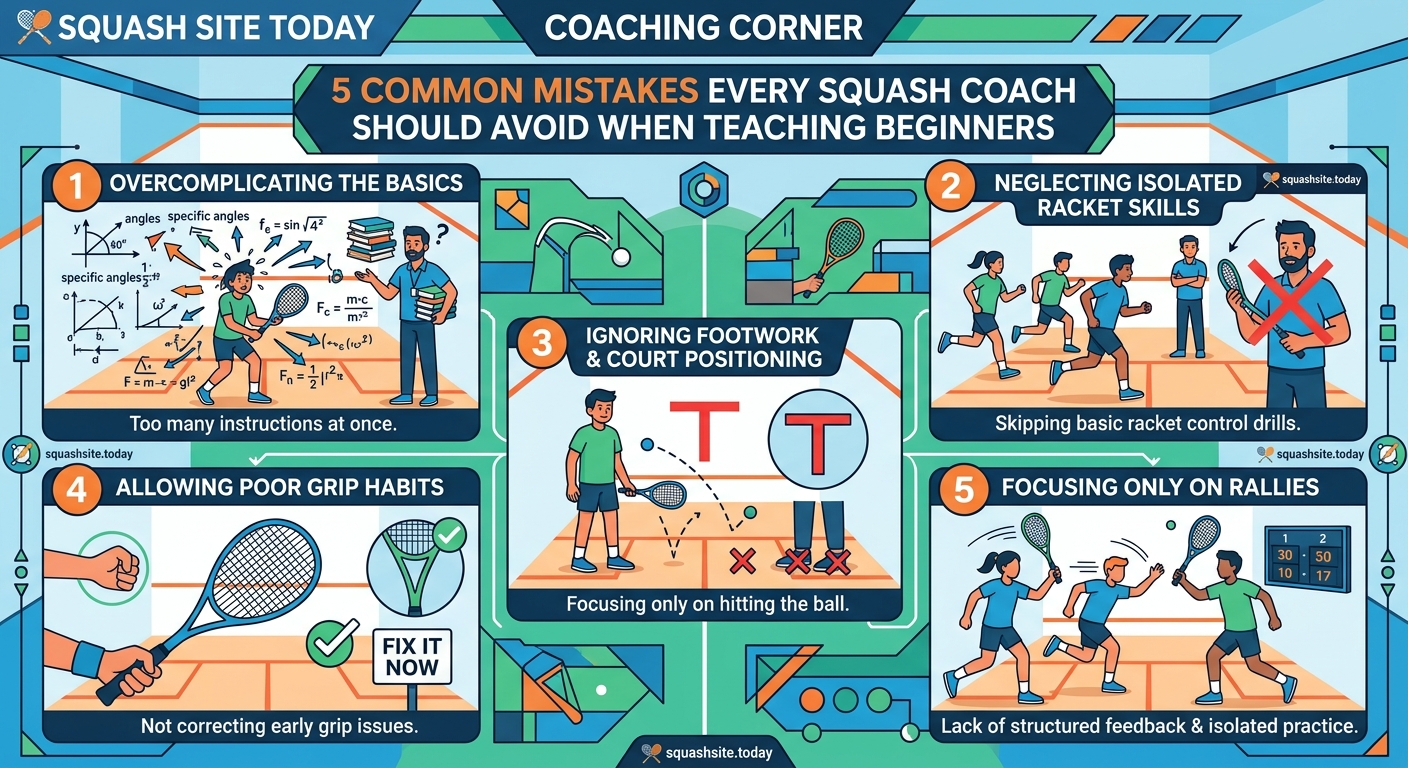
5 Common Mistakes Every Squash Coach Should Avoid When Teaching Beginners
Teaching beginners can be the most rewarding part of coaching. You watch someone pick up a racket for the first time and transform into a confident player who understands court positioning, swing mechanics, and tactical awareness. But here’s the problem: many well-intentioned coaches accidentally slow down that progress by repeating the same five mistakes. These errors don’t just frustrate beginners. They create bad habits that take years to unlearn.
Most squash coaching mistakes beginners experience stem from overcomplicating technique too early, neglecting footwork fundamentals, providing vague feedback, rushing progression through skill levels, and failing to make sessions enjoyable. Addressing these five areas transforms your coaching effectiveness and accelerates beginner development whilst building their confidence and long-term commitment to the sport.
Overloading beginners with technical detail too soon
Walk into any squash club and you’ll hear coaches breaking down the forehand drive into twelve separate components. Wrist angle. Elbow position. Hip rotation. Follow-through path. Weight transfer. Racket face angle.
The beginner stands there, paralysed by information.
They can’t possibly process all of that whilst trying to hit a moving ball. Their brain shuts down. They swing awkwardly. The ball hits the tin. They feel stupid.
This is the single most common mistake coaches make with new players.
Beginners need one or two simple cues, not a biomechanics lecture. “Turn your shoulders” works better than explaining the kinetic chain. “Hit through the ball” beats a dissertation on racket acceleration.
Your job is to simplify, not impress them with your technical knowledge.
How to fix it
Start with the outcome, not the process. Tell them where you want the ball to go. Show them what a good shot looks like. Let them attempt it. Then give one specific correction.
That’s it.
One correction per rally. One focus point per drill.
If their grip needs work, address that first. Once the grip feels natural, move to stance. Then swing path. Then follow-through.
Layer the technique gradually over weeks, not minutes.
The best coaches know that the perfect squash swing develops through repetition with minimal interference, not through exhaustive explanation before they’ve hit fifty balls.
Neglecting footwork whilst obsessing over swing mechanics
Here’s a truth that most coaches learn too late: beginners miss shots because they’re in the wrong position, not because their swing is terrible.
Yet coaching sessions focus 80% on technique and 20% on movement.
It should be the opposite.
A beginner with average swing mechanics but excellent court coverage will beat someone with a textbook forehand who can’t reach the ball. Every single time.
But footwork is boring to teach. It’s repetitive. There’s no immediate visual payoff like watching someone finally nail a drop shot.
So coaches skip it.
They let beginners shuffle around the court, flat-footed and slow, wondering why their shots lack power and consistency.
The power comes from the legs. The consistency comes from arriving at the ball with time to set up properly.
The footwork-first approach
Dedicate the first ten minutes of every session to movement patterns. Not as a warm-up. As the primary skill you’re developing.
- Shadow movement without the ball
- Ghosting routines from the T to each corner
- Split-step timing drills
- Recovery patterns back to the centre
Make it competitive. Time them. Create challenges. Reward improvement.
Once their feet are moving correctly, the swing improvements happen naturally because they’re hitting from a balanced, stable position.
If you’re serious about developing proper movement habits, ghosting routines that actually improve your court movement should be a non-negotiable part of your coaching programme.
Providing vague feedback that doesn’t help players improve
“Good try.”
“Nearly.”
“Better.”
“Keep going.”
This is noise, not coaching.
Beginners need specific, actionable feedback they can immediately apply. Vague encouragement feels supportive but provides zero information about what to change.
Compare these two pieces of feedback:
Vague: “Your backhand needs work.”
Specific: “You’re swinging across your body. Keep your elbow away from your torso and finish with your racket pointing at the front wall.”
The second version gives them something concrete to attempt on the next shot.
Most coaches fall into the vague feedback trap because they’re watching too many things at once. They see that something is wrong but haven’t identified the precise error.
The feedback formula that works
Use this three-part structure for every correction:
- Identify the specific error
- Explain the consequence
- Provide one actionable fix
Example: “You’re standing too upright when you lunge. That’s why you’re losing balance. Bend your front knee more and keep your chest over your toes.”
Now they know what they did wrong, why it matters, and exactly what to change.
This approach transforms your coaching from cheerleading to actual skill development.
| Vague Feedback | Specific Feedback |
|---|---|
| “Hit it harder” | “Accelerate your racket through contact” |
| “Watch the ball” | “Keep your eyes on the ball until after you’ve made contact” |
| “Move faster” | “Push off your back foot and take three steps, not five” |
| “Better positioning” | “Return to the T between shots, don’t watch your shot” |
Rushing progression before fundamentals are solid
You’ve been coaching a beginner for three weeks. They can hit a forehand drive. Sometimes. When the ball comes to them nicely.
So you introduce the drop shot.
Bad idea.
They’re not ready. Their straight drive is inconsistent. Their footwork is still developing. Their racket control is shaky.
But you’re bored of drilling drives. You want to keep sessions interesting. You think variety will maintain their engagement.
Instead, you’ve just confused them and undermined their confidence.
Beginners need depth, not breadth. They need to master the fundamental shots before attempting advanced techniques.
A player who can hit 20 consecutive straight drives with good length and accuracy is better equipped for match play than someone who can attempt eight different shots but execute none of them reliably.
Building a solid foundation
Follow this progression checklist before moving to the next skill level:
- Can they hit the shot with correct technique during solo feeding?
- Can they maintain technique during paired rally drills?
- Can they execute the shot under pressure in conditioned games?
- Can they choose to use the shot appropriately in free play?
If the answer to any of these is no, they’re not ready to progress.
This doesn’t mean sessions become monotonous. You can create dozens of variations on straight drive practice. Change the feeding pattern. Adjust the target zones. Add movement requirements. Introduce competitive scoring.
But don’t introduce the boast until they can drive straight consistently.
The temptation to rush is strongest when coaching keen beginners who are desperate to learn everything immediately. Resist it. Your job is to build players who are still improving in five years, not to show them every shot in five weeks.
Understanding are you making these 7 footwork mistakes on the T helps you recognise when a beginner is ready for more complex movement patterns and when they need more time on the basics.
Forgetting that beginners need to enjoy themselves
This is the mistake that costs you students.
You can have perfect technical knowledge. You can structure brilliant progressions. You can provide detailed feedback.
But if your sessions are joyless slogs through repetitive drills, beginners won’t come back.
They’re not professional athletes. They’re not getting paid. They’re showing up because they want to enjoy themselves whilst learning a new skill.
Too many coaches treat every session like they’re preparing someone for the British Open. Serious faces. Constant corrections. No laughter. No games. Just drill after drill after drill.
Beginners quit because they’re bored, not because they’re not improving.
Making sessions engaging without sacrificing quality
You don’t have to choose between fun and effective coaching. The best sessions deliver both.
Here’s how:
Use competitive games, not just drills. Instead of hitting 50 straight drives, play “first to 10 points” where they score for hitting above the service line.
Celebrate improvement, not perfection. When they hit three good shots in a row for the first time, make a big deal of it.
Vary the pace. Mix intense five-minute drills with lighter skill challenges. Don’t grind them into exhaustion.
Tell stories. Share examples from professional matches. Explain why certain techniques matter using real-world scenarios.
End on a high note. Finish every session with something they can do well, not something they’re struggling with.
“The best coaches I’ve worked with made me feel like I was getting better every single session, even when I was struggling. They found something to praise, something to work on, and something to look forward to next time.” – Club player reflecting on their first year learning squash
Remember that beginners are forming their relationship with the sport during these early sessions. If that relationship is built on enjoyment and steady progress, they’ll stick with squash for years. If it’s built on frustration and feeling inadequate, they’ll drift away after a few months.
Your technical expertise matters less than your ability to keep them engaged and motivated.
Building confident players through better coaching
The difference between average coaching and excellent coaching isn’t about how much you know. It’s about how effectively you transfer that knowledge to beginners without overwhelming them.
Focus on one technical point at a time. Prioritise footwork over fancy shots. Give specific feedback they can actually use. Don’t rush progression before they’re ready. Make every session something they look forward to attending.
These five adjustments will transform your coaching effectiveness and create beginners who develop into confident, capable players.
The best part? These aren’t complex changes requiring years of experience to implement. You can apply them in your next session.
Start with one mistake. Fix it. Then move to the next.
Your beginners will thank you for it.