4 Essential Resistance Band Exercises Every Squash Player Should Try
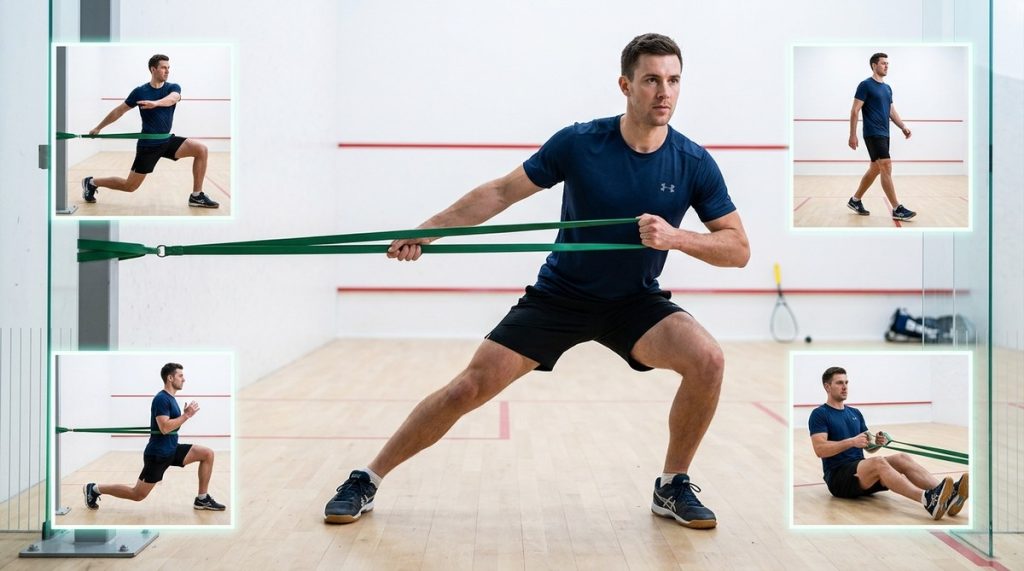
If you want to move faster, hit harder, and stay injury-free on court, resistance bands should be part of your training. These simple tools mimic the demands of squash perfectly: explosive lateral pushes, deep lunges, and rotational control. Whether you are a club player grinding through the league or a junior aiming for national colours, adding these four movements to your weekly routine will transform your game without needing a gym membership.
Resistance bands provide targeted, low-impact strength training that directly improves your squash movement. The four exercises in this guide strengthen the glutes, hamstrings, core, and shoulders, giving you more explosive first steps, deeper lunges, and better rotation. Add them to your weekly routine to build resilience, reduce injury, and stay sharp through the fifth game.
Why Resistance Bands Are a Perfect Fit for Squash
Squash demands a unique blend of strength, speed, and control. You need to push off laterally to cover the T, hold deep lunges at the front corners, and rotate your torso to generate power on drives. Resistance bands are brilliant for this because they provide variable resistance that matches the force curve of these movements.
Here are the main benefits for squash players:
- Mimics court-specific angles – bands allow you to train the exact planes of motion used in lunging, shuffling, and rotating.
- Joint-friendly – unlike heavy weights, bands place minimal stress on your knees and lower back. This is especially valuable late in the season when niggles creep in.
- Portable and cheap – you can get a quality set for under £20 and use them at home, in the gym, or even on the court before your match.
- Improves stability – many exercises force your stabiliser muscles to work overtime, which carries over to better balance during rallies.
- Easy to progress – simply switch to a thicker band or increase your reps to keep challenging your muscles.
For a deeper look at how to structure all your off-court work, check out how to structure your weekly training for maximum court performance.
The Four Essential Resistance Band Exercises for Squash Players
Each of the following exercises targets a specific movement pattern you use on court. Perform them after a light warm-up (jogging, dynamic stretches) and aim for 2 to 3 sessions per week.
1. Lateral Band Walks
This move builds strength in your glute medius and hip stabilisers. Strong hips keep your knees aligned when you push off the T or cover a boast.
How to do it:
- Place a resistance band just above your ankles (or around your knees for a slightly easier version).
- Stand with your feet hip-width apart and your knees slightly bent. Keep your chest up and your weight on your heels.
- Take a controlled step to the side with your right foot. Your feet should never touch.
- Follow with your left foot, returning to the starting width.
- Complete 10 steps to the right, then 10 steps to the left. That is one set. Do 3 sets.
Pro tip: Stay in a half-squat position throughout. If your knees cave inward, try a lighter band or move the band to just above your knees.
2. Banded Romanian Deadlift (RDL)
The RDL targets your hamstrings and glutes, which are crucial for explosive acceleration out of a lunge. Weak hamstrings are also a common cause of groin strains and lower back pain.
How to do it:
- Stand in the centre of a long band. Your feet should be shoulder-width apart.
- Bring both ends of the band up to hip height. Hold them with an overhand grip, arms straight.
- Keeping your back flat and your knees slightly bent, hinge at the hips and push your bottom backward.
- Lower the band until you feel a stretch in your hamstrings (usually around shin level). Do not let your lower back round.
- Drive your hips forward to return to standing. Squeeze your glutes at the top.
Complete 12 repetitions for 3 sets. Use a band that makes the last 2 reps challenging but controlled.
3. Banded Rotational Press (Anti-Rotation)
This is a core exercise that teaches your torso to resist rotation. Squash players often rotate too early on drives, losing power. The anti-rotation press builds the strength to hold your trunk stable.
How to do it:
- Anchor a band at chest height to a post, door frame, or a heavy dumbbell.
- Stand sideways to the anchor point. The band should be at your sternum level.
- Hold the band with both hands directly in front of your chest.
- Press your hands straight forward until your arms are fully extended. Do not let your body twist toward the anchor.
- Hold for 2 seconds, then bring your hands back to your chest.
Do 10 repetitions on each side. Focus on keeping your core braced and your hips facing forward. If you feel your lower back arching, reduce the band tension.
4. Banded Squat to Overhead Press
This compound movement links lower body power with upper body expression. In squash, you often need to generate force from your legs and transfer it through your core and shoulders into the racket.
How to do it:
- Stand on a band with your feet shoulder-width apart. Hold the band at your shoulders, palms facing forward.
- Keep your chest up and your weight in your heels as you squat down to parallel.
- Drive through your heels to stand up, and simultaneously press the band overhead.
- Lower the band back to your shoulders and repeat.
Aim for 8 to 10 reps for 3 sets. The squat and press should happen in one fluid motion.
Common Mistakes and How to Fix Them
Even with good intentions, small errors can reduce the effectiveness of these exercises or lead to injury. Use the table below to check your form.
| Exercise | Common Mistake | Correct Technique |
|---|---|---|
| Lateral Band Walk | Knees collapsing inward | Keep knees in line with toes, maintain a slight squat |
| Banded RDL | Rounding the lower back | Hinge at hips, keep spine neutral, look a few feet ahead |
| Rotational Press | Entire body rotates with the press | Brace core, only arms move forward, hips stay square |
| Squat to Press | Leaning forward onto toes | Keep weight in heels, chest up, break at hips first |
“Resistance bands are one of the most underrated tools in a squash player’s kit. They allow you to train the specific angles and speeds required on court without the impact of repeated court sessions. I recommend these four movements to every player I coach, from beginners to national squad members.” – Mark Chaloner, former PSA World No.5 and current England Squash coach.
How to Add These Exercises to Your Training Week
Consistency matters more than intensity. Start by doing the full circuit twice a week, ideally on days when you are not playing a match. You can place it after your on-court session or as a standalone workout.
A simple weekly plan could look like this:
- Monday: On-court practice + resistance band circuit (2 sets of each exercise).
- Wednesday: Resistance band circuit (3 sets of each) + light cardio.
- Friday: Match play or solo drills.
If you want to improve your court movement further, combine these bands with specific footwork work. Our guide on ghosting routines that actually improve your court movement pairs perfectly with the strength you build here.
Also, these exercises are great for injury prevention. If you struggle with knee pain, the lateral band walks and banded RDL will strengthen the supporting muscles around your knees and hips. For more advice on protecting your joints, read the complete guide to squash lunging.
Choosing the Right Band
For these exercises, you will need a few bands of different resistance levels. Light bands (extra light to light) are best for lateral walks and rotational presses. Medium bands work well for the RDL and squat to press. If you can comfortably complete all reps and sets, move up to the next resistance.
Look for bands that are at least 60 cm long for the RDL, and a loop band for the lateral walks. Many brands offer sets with three or four resistances for around £15 to £25. It is a small investment that pays off in fewer injuries and stronger movement.
Make Resistance Bands a Staple in Your Training Routine
You do not need a huge time commitment to see results. Fifteen minutes twice a week with a resistance band will strengthen the key muscle groups that squash demands. After four to six weeks, you will notice your lateral movement feels sharper, your lunges are deeper, and your core stays solid when you generate power.
Grab a band, set aside a short slot in your week, and stick with it. Your body will thank you when the fifth game arrives and your opponent is the one struggling to keep up.