How Squash Racket String Patterns Affect Spin and Control on UK Courts
You have probably felt it. That moment when you try to flick a crosscourt nick from the back of the court, and the ball just slides off the strings with no bite. Or when you attempt a tight drop shot and it floats long instead of dying in the front corner. The difference between those outcomes often comes down to one thing: your string pattern.
The string pattern on your racket is not just a cosmetic detail. It changes how the ball interacts with the strings, how much grip you get, and how much control you have over your shots. On UK courts, where the ball can play differently depending on the temperature and court surface, understanding squash racket string pattern spin control can give you a real edge.
Open string patterns (14×18 or 16×18) generate more spin and bite on the ball, making them ideal for drop shots and attacking play. Dense patterns (18×20) offer greater control and accuracy for drives and defensive shots. UK club players should match their string pattern to their playing style and the specific conditions of their local court. A 16×19 pattern offers a balanced middle ground.
Open vs Dense: The Core Difference
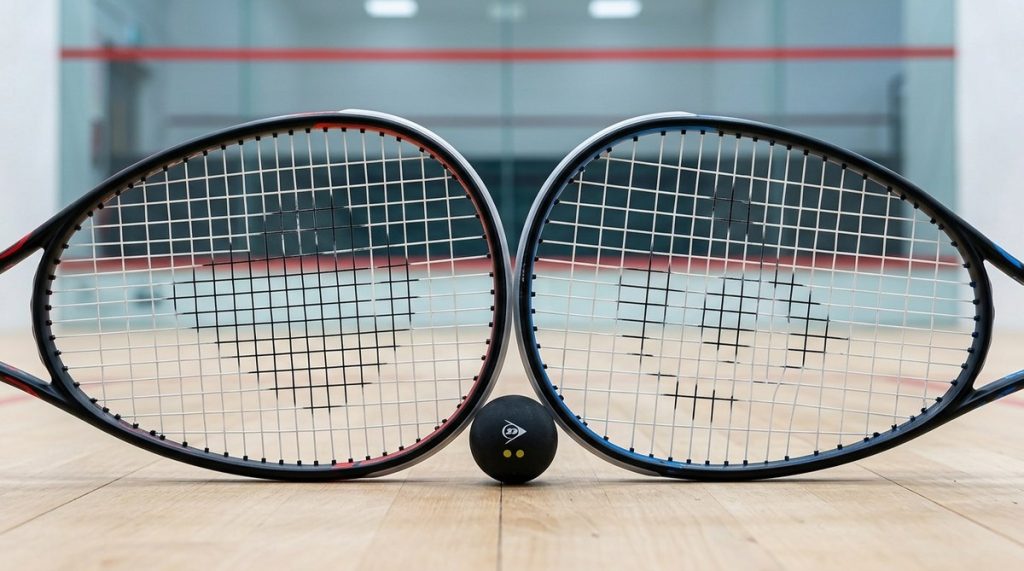
Let us start with the basics. A string pattern is described by two numbers. The first is the number of main strings (the vertical ones). The second is the number of cross strings (the horizontal ones). A 14×18 pattern has 14 mains and 18 crosses. An 18×20 pattern has 18 mains and 20 crosses.
The key difference is spacing. Open patterns have bigger gaps between the strings. Dense patterns have the strings packed closer together.
Here is how that affects your game:
- Open patterns (14×18, 16×18): More space between strings allows the ball to sink deeper into the string bed. This creates more friction and grip, which helps you generate spin. The trade off is slightly less precision on flat shots.
- Dense patterns (18×20): Tighter string spacing means the ball sits on top of the strings more. You get a firmer, more predictable response. This is better for driving the ball straight and hitting accurate length shots.
- 16×19 patterns: A popular compromise. You get decent spin potential without sacrificing too much control. Many intermediate players find this a safe starting point.
How String Pattern Affects Spin on UK Courts
UK squash courts vary a lot. Some clubs have traditional plaster walls. Others have modern panelled surfaces. The temperature in British courts can drop during winter months, making the ball harder and less bouncy. These factors change how much spin you can generate.
An open string pattern helps you compensate for a cold, dead ball. The extra bite from the strings lets you put more rotation on the ball, which helps it grip the front wall and die in the corner. This is why many attacking players in the UK prefer a 14×18 or 16×18 pattern.
On the other hand, if you play on a court that runs warm and lively, a dense pattern gives you the control you need to keep the ball tight. You do not want extra spin making the ball kick off the side wall unpredictably. You want a clean, direct response from the string bed.
Expert advice from a UK level 3 coach: “I tell my players to think of the string pattern like the tread on a tyre. Open patterns are like winter tyres. They give you grip when conditions are slippery. Dense patterns are like summer tyres. They give you precision on a dry road. Know your court conditions before you choose.”
Choosing the Right Pattern for Your Playing Style
Your style of play should guide your choice. Here is a breakdown of which patterns suit different approaches.
| Playing Style | Recommended Pattern | Why It Works |
|---|---|---|
| Attacking shot-maker (lots of drops, boasts, nicks) | 14×18 or 16×18 | More spin on drop shots. Better bite for tight boasts. |
| Patient grinder (long rallies, deep drives) | 18×20 | Consistent response on drives. Less unwanted spin. |
| All-court player (mix of attack and defence) | 16×19 | Balanced spin and control. Versatile for different shots. |
| Volley-heavy player (taking ball early) | 16×19 or 18×20 | Firmer feel for crisp volleys. Less trampoline effect. |
The Practical Process: How to Test String Patterns
If you are not sure which pattern suits you, do not guess. Test them systematically.
- Borrow or demo rackets with different patterns. Most UK squash shops and pro shops at clubs will let you try before you buy. Ask your club coach if they have demo rackets.
- Spend 10 minutes on each pattern doing the same drill. Hit ten straight drives. Then ten crosscourt drives. Then ten drop shots from the same position. Notice the difference in feel.
- Rate each pattern on three factors: spin you can generate, control on drives, and comfort on off-centre hits. A 16×19 pattern often scores well across all three.
- Play a practice match with your top two choices. Do not just hit drills. See how the pattern behaves under pressure when you are tired and your technique breaks down slightly.
- Make your decision based on your most common shots. If you win points with drop shots, prioritise spin. If you win by wearing opponents down, prioritise control.
Common Mistakes Players Make
Even experienced players get this wrong. Here are the most frequent errors.
- Copying a pro without thinking about your own game. Mohamed ElShorbagy might use a certain pattern, but he also has elite technique and string tension that you do not. His choice might not work for you.
- Ignoring string tension when changing pattern. If you switch from an 18×20 to a 14×18, you may need to increase tension by 1-2 kg to maintain control. The open pattern naturally gives more power, so higher tension compensates.
- Sticking with the same pattern for every court. If you play league matches at different clubs with different court conditions, consider having two rackets strung with different patterns. One for cold courts, one for warm courts.
- Assuming a denser pattern always means more control. That is true for flat shots. But if you rely on spin to control the ball, a dense pattern can actually reduce your control because you cannot put enough rotation on the ball.
Matching String Pattern with String Type
The pattern is only half the story. The type of string you use changes how the pattern performs.
- Multifilament strings (softer, more feel) work well with open patterns. The extra elasticity helps you grip the ball for spin.
- Monofilament strings (stiffer, more durable) pair better with dense patterns. The firm string bed gives you the precision you need.
- Textured strings (rougher surface) can add spin to any pattern. If you have a dense pattern but want more bite, try a textured string before switching rackets.
For more detail on string types, read our guide on how to choose the right squash racket strings for power and control.
How Court Temperature Changes the Equation
British squash players know this well. A court at 8 degrees Celsius in January plays very differently to a court at 22 degrees in July.
When the ball is cold and hard, it compresses less on impact. An open string pattern helps because the ball sinks deeper into the string bed, giving you more time to impart spin. A dense pattern on a cold ball can feel like hitting a golf ball with a frying pan. There is no grip.
When the ball is warm and lively, it bounces more and compresses easily. A dense pattern helps you control that extra bounce. An open pattern on a hot ball can feel too lively, making the ball fly off the strings.
If you play in a club with inconsistent heating, keep a second racket with a different pattern in your bag. Switch based on how the ball feels in the warm-up.
A Balanced Approach for Club Players
Most intermediate to advanced club players in the UK do not need an extreme pattern. A 16×19 pattern is a solid choice for the majority of players. It gives you enough spin to execute attacking shots, but enough control to keep your drives tight.
If you find yourself wanting more bite on your drop shots, then move to a 16×18 or 14×18. If you feel like your drives are inconsistent and the ball is flying long, move to an 18×20.
Do not be afraid to experiment. String patterns are not permanent. You can change them with every restring. Try a new pattern for a month and see how it affects your match results.
Your Next Steps on the Court
Understanding squash racket string pattern spin control is not about memorising numbers. It is about feeling the difference on your racket and adjusting based on your game and your court.
Book a court session where you do nothing but test patterns. Bring a friend. Hit the same shots with two different rackets. Notice how the ball reacts off the front wall. Notice how much effort you need to generate spin. Notice which pattern gives you confidence under pressure.
Once you find the right match, your game will feel more connected. Your drop shots will bite. Your drives will stay tight. And you will wonder why you did not pay attention to string patterns sooner.
For more on getting the most from your equipment, check out our guide on the truth about squash string tension and how it transforms your game.