How to Build a Winning Game Plan with Your Squash Players
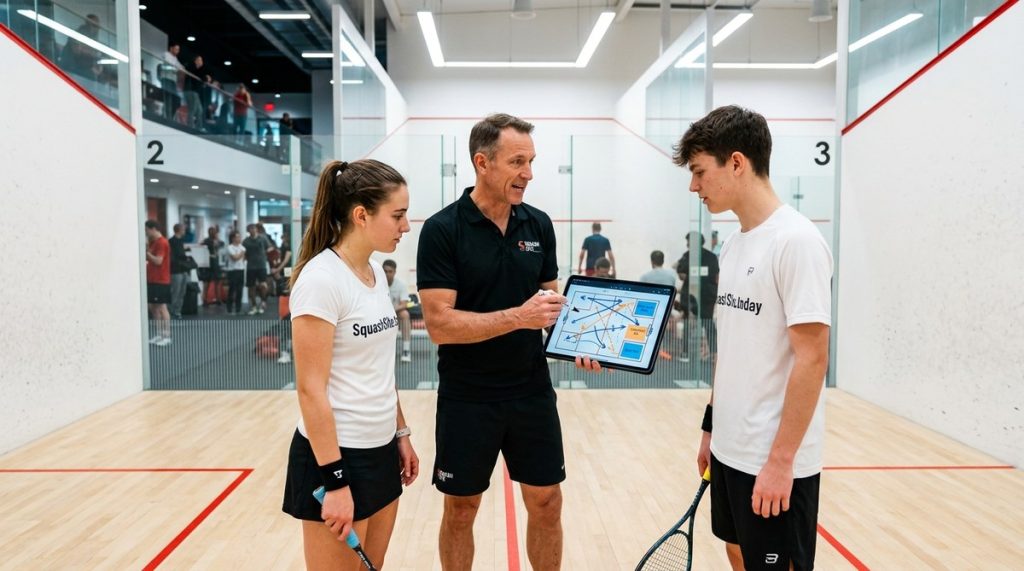
Every training session starts with a purpose, but without a game plan that same purpose can disappear the moment your players step onto court. A game plan turns ability into results. It gives structure to talent and helps your players stay ahead of the opponent. For a coach, teaching that process is one of the most valuable skills you can pass on. Here is how to build a winning game plan with your squash players using proven methods that work in club leagues, county competitions, and even PSA tournaments.
A winning game plan combines opponent analysis, tactical clarity, and realistic execution. Start by identifying your player’s strengths and the opponent’s weaknesses. Build the plan around four key areas: serves, returns, rally patterns, and shot selection. Practice the plan in targeted drills. Review and adapt during the match using a three-point assessment system. The best plans are simple enough to remember under pressure.
Why a Game Plan Separates Good Players from Great Ones
A player without a plan relies on instinct. That works when they are in form, but in a tight match instinct can lead to bad shot choices. A game plan acts as a mental anchor. It tells your player what to do when the scoreboard tightens and the pressure rises.
Think about the difference between a player who improvises every rally and one who follows a tactical framework. The second player will always be more consistent. They know when to attack, when to defend, and which patterns give them the best chance to win. This is not about overcomplicating things. It is about giving your players a simple set of rules to follow.
A Step-by-Step Process to Build a Game Plan
To build a game plan that works, follow this numbered sequence. Each step builds on the last. Do not skip steps, especially the first two.
Step 1: Analyse Your Player’s Strengths
Before you look at the opponent, understand what your player does best. Is their movement exceptional? Do they have a deadly backhand drop? Are they fitter than most opponents at your club? Write down three technical strengths and two tactical strengths.
Step 2: Scout the Opponent
If possible, watch the opponent play or ask someone who has played them recently. Look for these factors:
- Their preferred serve location (forehand or backhand side)
- Their rally pace (do they like slow or fast rallies?)
- Their movement on the T (do they recover quickly?)
- Their weaknesses under pressure (e.g., poor boasts, erratic length)
If you cannot watch them, make educated assumptions based on their playing style you have seen before. Use the first three points of the match to confirm or adjust.
Step 3: Choose a Core Tactical Theme
Every game plan revolves around one big idea. For example:
- Dominate the T and force the opponent into the back corners
- Attack the opponent’s weaker backhand side with high drives
- Use heavy length to tire out a less fit opponent
- Vary pace to disrupt a rhythm player
Pick one theme. Do not try to do everything at once.
Step 4: Plan the First Three Serves
Your player should know exactly where they will serve for the first three points. This removes hesitation. Practice these serves in the warm-up.
- If your player has a strong serve to the backhand, use it to establish control.
- If the opponent struggles with volleying, serve to the middle to force a weak return.
Step 5: Map Out Return of Serve
Decide how your player will return each type of serve. Will they volley the serve or take it off the back wall? Will they aim for a straight drive or a crosscourt boast? Having a predetermined return reduces the chance of a sloppy shot.
Step 6: Practise the Plan in the Session
Once the plan is clear, run through it in practice. Use condition games: “Only hit straight drives for the first five rallies.” Or “Serve to the backhand and then attack any short ball.” This builds muscle memory.
Step 7: Establish Checkpoints
During the match, your player should check the plan at specific points: after the first game, after the third game, and when the score reaches 8-8. If the plan is not working, they should adjust using the three-point assessment (more on that below).
Table: Game Plan Elements vs. Reactive Play
The table below compares the key differences between playing with a structured game plan and playing reactively.
| Aspect | Game Plan Approach | Reactive Play |
|---|---|---|
| Serve location | Predetermined and targeted | Random or based on habit |
| Return selection | Planned for opponent weakness | Chosen in the moment |
| Rally length | Controlled to suit fitness | Influenced by opponent |
| Shot variety | Deliberate and patterned | Inconsistent |
| Recovery on T | Prioritised after every shot | Often late |
| Mental focus | High and directed | Variable |
| Adaptation | Systematic (e.g., 3-point check) | Emotional or slow |
Common Mistakes When Building a Game Plan
Even experienced coaches sometimes fall into traps that weaken the plan. Watch out for these errors.
- Making the plan too complex. A game plan with five different objectives will confuse your player mid-match. Keep it to three points maximum.
- Ignoring the opponent’s adjustments. Your plan must be flexible. If the opponent starts covering one pattern, you need a second option.
- Overlooking your player’s energy levels. A plan that relies on high-intensity movement might work in game one but fail in game four if your player is not fit enough.
- Forgetting to rehearse the plan. Talking through the plan in the changing room is not enough. Get on court and practise the specific patterns.
How to Adapt a Game Plan Mid-Match
No plan survives first contact with the opponent unchanged. That is normal. The skill is knowing when and how to adjust.
“The best game plans are like a good recipe. You follow it, but you taste as you go and add a pinch of salt if needed.” — Paul Assaiante, legendary college squash coach.
Use the three-point assessment system. After every three points, ask your player (or yourself if you are the player) three questions:
- Is my opponent winning because of their strengths or my weaknesses?
- What is the one shot they are struggling with most?
- Can I force them to play that shot more often?
If the answer to question one is “their strengths”, change the pattern. For example, if they are dominating with crosscourt drives, start volleying and cutting them off. If the answer is “my weaknesses”, fix your position or shot selection.
Practical Example
Your player is losing because the opponent keeps hitting deep, low drives to your player’s backhand. Your player is late to the ball and hitting weak returns. The adjustment: have your player take a slightly earlier prep position on the backhand side and use a higher length to give themselves more time. This simple tweak can turn the rally around.
Preparing Your Player Mentally for the Game Plan
A game plan only works if your player believes in it. That is why you must involve them in the process. Do not hand them a list of instructions. Ask them what they think they should do. Guide them with questions: “Where do you think their serve is weakest?” “How could you make them run more?” When the plan feels like their own idea, they will execute it with more confidence.
Also, remind them that a game plan is not a guarantee of winning. It is a framework to increase their chances. If the plan does not work, they have not failed. They just need to adjust.
Involving the Team in Your Club
If you coach multiple players, create a shared library of opponent profiles. Keep notes on serving patterns, fitness levels, and shot preferences. This saves time and builds a culture of tactical awareness at your club. You can also use a simple group chat to share observations after matches.
For more ideas on building community around your squash programme, read about how to organise a successful club championship in 6 simple steps.
How to Practise Game Plans Without a Partner
Sometimes your players need to work on game plan execution alone. That is where solo drills and ghosting become invaluable. Use ghosting routines that actually improve your court movement to reinforce the positioning needed for specific game plans. For example, if the plan is to attack the front court after a short serve, ghost the movement from the T to the front corners.
You can also design solo drills that mimic the shot patterns of a game plan. The solo court drills article offers 12 exercises that can be adapted to any tactical theme.
Final Thoughts on Building Winning Game Plans
A winning game plan is not about having a secret tactic that your opponent cannot handle. It is about knowing your own strengths, understanding the opponent’s weaknesses, and sticking to a simple structure that gives you the best chance to win. The best squash game plan tips are the ones that your player can actually remember when the score is tight and the pressure is on.
Start small. Pick one opponent this week and build a plan with your player. Review it together after the match. Learn what worked and what did not. Over time, your players will develop the confidence to build their own game plans on the fly. That skill will serve them for the rest of their squash journey.