The Best Squash Racket for Every Playing Style in 2026: From Power Hitters to Finesse Players
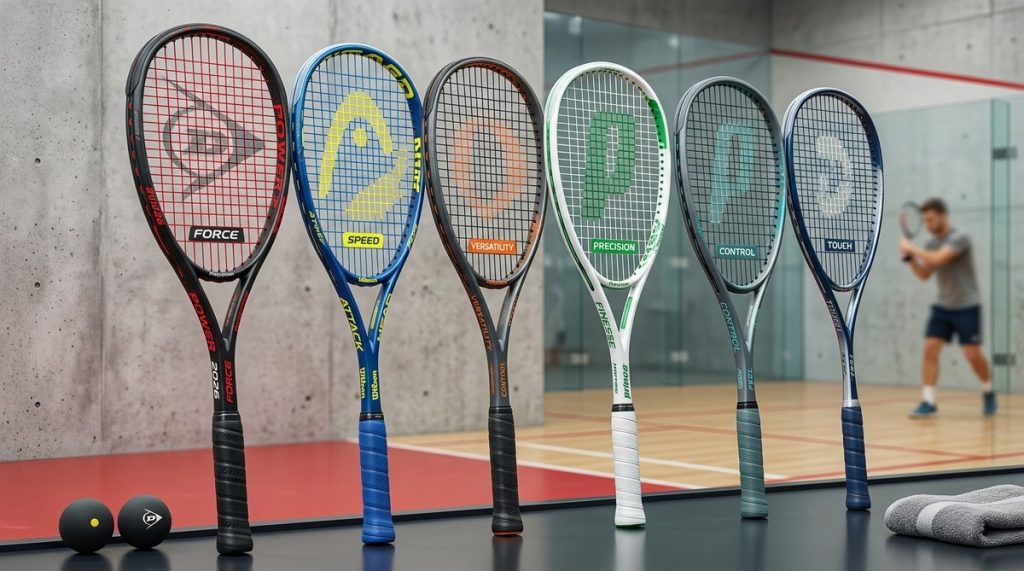
Choosing a new squash racket in 2026 can feel like navigating a crowded pro shop. You pick one up, waggle it, and wonder if it will transform your game. The truth is, the best squash racket for playing style is the one that amplifies what you already do well. A power hitter needs a different tool than a finesse player. This guide breaks down exactly which racket characteristics suit each approach, so you can buy with confidence.
Your playing style dictates your racket. Power players need a head-heavy frame with a stiff shaft for explosive drives. Finesse players need a balanced or head-light frame for touch and ball control. Match your technique to the racket’s weight, balance, and string pattern. Testing a demo before buying is the single best way to avoid a mismatch.
Power Hitters: When You Need Raw Pace
If your game relies on smashing the ball past your opponent with sheer velocity, you are a power hitter. You generate racquet head speed through strong legs and a fast arm swing. Your priority is converting that effort into ball speed.
For you, the best squash racket for playing style is one with a head-heavy balance. This means more mass in the frame head, which adds momentum to your swing. You do not need to swing harder; the racket does the work for you. Look for a frame weight around 130 to 140 grams with a stiff shaft. A stiff shaft transfers energy efficiently without twisting on impact.
Top characteristics for power players:
– Head-heavy balance point (closer to the top of the frame)
– Stiff shaft for maximum energy transfer
– Weight between 130g and 140g
– A dense string pattern for a firmer hitting surface
A classic example is the Tecnifibre Carboflex 125. It has been a staple for aggressive players for years because of its stiff feel and head-heavy nature. In 2026, newer models like the Head Radical Pro also offer a similar profile with modern materials. If you love hitting the ball hard and watching it rocket off the strings, this is your lane.
Expert advice: “Power is nothing without control. A head-heavy racket can punish your wrist if your technique is sloppy. Always pair a powerful frame with a grip that fits your hand perfectly.”
Finesse Players: Touch, Feel, and Precision
Finesse players win through deception, placement, and touch. You rely on drop shots, lobs, and delicate angles to outsmart your opponent. You rarely try to overpower the ball; instead, you caress it to the target.
For this style, the best squash racket for playing style is lighter and more balanced. You want a frame that responds to subtle wrist movements. A balanced or slightly head-light racket gives you supreme control. You can hold the ball on the strings longer before releasing it, which is critical for disguising your shot direction.
Top characteristics for finesse players:
– Balanced or head-light weight distribution
– Flexible shaft for extra dwell time on the strings
– Weight under 125g (often 115g to 120g)
– Open string pattern for better feel and spin
The Dunlop Biomimetic series is a favourite among finesse players. Its frame is designed to flex on impact, holding the ball for a fraction of a second longer. This allows you to guide the ball precisely. Similarly, the Prince Airo X line offers a head-light feel that rewards soft hands. If you enjoy painting the corners of the court with your shots, a lighter, flexible frame is your match.
The All-Rounder: Hybrid Performance
Not everyone fits neatly into a box. Many intermediate and advanced players mix power and finesse depending on the match situation. One rally you might smash a cross-court drive; the next you might drop a soft winner from the baseline.
For the hybrid player, the best squash racket for playing style is a medium-weight frame with a slightly head-heavy balance but a flexible shaft. This combination gives you enough mass for power shots without sacrificing touch for drop shots. Look for frames weighing 125g to 130g.
Top characteristics for hybrid players:
– Medium weight (125g to 130g)
– Slightly head-heavy balance for power, but not extreme
– Medium shaft stiffness (flexible enough for control, stiff enough for power)
– Versatile string pattern (often a 16×19 hybrid pattern)
The Babolat Pure Control 2026 edition is a standout here. It offers a balanced feel that leans slightly towards power, but the frame flex allows for excellent ball handling. The Wilson Hyper Hammer 2.0 also bridges this gap well. It is forgiving on off-centre hits but still provides enough pop for aggressive strokes.
How to Match Your Technique to the Racket
You now know the categories. The next step is matching your specific technique to the racket’s specs. Use this table to clarify common mistakes.
| Your Technique | Mistake to Avoid | Racket Solution |
|---|---|---|
| You smash hard but lack control | Using a very flexible, light racket | Switch to a stiffer, head-heavy frame |
| You rely on drop shots but hit them long | Using a stiff, head-heavy racket | Switch to a balanced, flexible frame |
| You have a fast wrist snap | Using a heavy racket (over 135g) | Drop to a lighter frame (under 125g) |
| You hit the ball late on the backhand | Using a racket with a large head | Try a head-light frame for earlier contact |
| You struggle with spin on volleys | Using a closed string pattern | Try an open pattern for more string movement |
Three Steps to Test Your Racket Before Buying
You cannot rely on specs alone. You must test the racket. Here is a simple process.
- Shadow swing in the shop. Hold the racket at the grip and make slow, deliberate swings. Does it feel head-heavy? Does it wobble? A racket that feels unbalanced in your hand will feel worse under match pressure.
- Bounce a ball on the strings. This is an old trick. Bounce a squash ball on the string bed. A stiff frame will give a sharp, high-pitched bounce. A flexible frame will give a softer, lower-pitched thud. Listen to the difference.
- Hit 20 balls on a practice court. Most pro shops have a hitting bay or a court you can use. Hit drives, volleys, and drop shots. Pay attention to how the racket feels at impact. Does it vibrate? Does it twist? Your hand should feel stable and connected.
The Balance Between Weight and String Tension
Many players obsess over frame weight but ignore string tension. The best squash racket for playing style also depends on how tight your strings are. Higher tension gives more control but less power. Lower tension gives more power but less precision.
If you are a power hitter, you can afford slightly lower tension because your swing speed compensates. If you are a finesse player, keep your tension higher. You need the strings to snap back quickly for those delicate shots. For more on this, read our guide on how to choose the right squash racket strings for power and control.
Why Grip Size Changes Everything
You can have the perfect frame, but if the grip is wrong, you will struggle. A grip that is too thick stops you from using your wrist. A grip that is too thin makes you squeeze too hard, causing fatigue.
Consider these grip rules:
– If your fingers overlap your palm when holding the racket, the grip is too small.
– If your fingers do not touch your palm at all, the grip is too large.
– The ideal grip lets your fingers just brush your palm.
This is especially critical for finesse players who rely on wrist action. A correct grip lets you angle the racket face precisely. For a deeper look, see our article on why your squash racket grip size actually matters more than you think.
The 2026 Market: What Has Changed?
This year, manufacturers have focused on reducing weight without sacrificing stiffness. Carbon fibre layering has improved. You can now find frames that weigh 120g but feel as stiff as a 135g racket from five years ago. This is great news for hybrid players who want the best of both worlds.
Another trend is customisable balance. Some brands now sell interchangeable weight inserts in the frame head. This lets you adjust the balance point from head-light to head-heavy. It is a premium feature, but it means one racket can grow with your playing style. If you are serious about finding the best squash racket for playing style, look for models with this flexibility.
Your Next Step on the Court
Finding the best squash racket for playing style is not about picking the most expensive or the lightest model. It is about honest self-assessment. Are you a power hitter who needs mass and stiffness? Are you a finesse player who needs touch and flex? Or are you a hybrid who needs a compromise?
Once you know your style, use the spec guidelines above to narrow your search. Test two or three rackets that fit your profile. Pay attention to how they feel during a rally, not just during a static swing. Your racket is an extension of your arm. When it fits, your game will flow.
For more on building the technique that makes any racket sing, check out our guide on refining your squash technique for consistent power and accuracy. And if you are on a budget, do not miss our list of 5 budget-friendly squash rackets that perform like premium models.