5 Mental Exercises That Will Transform Your Squash Performance
You step onto court for the fifth game, level at two games apiece. Your legs feel heavy, but that is not the real problem. The real problem is the noise in your head. The voice that says you are going to lose. The fear of missing the next drop shot. The memory of that tin you hit last game. Every squash player knows this moment. The difference between winning and losing often comes down to one thing: how well you control your mind.
Physical training gets all the attention, yet the mental side of squash is what separates good players from great ones. Professionals like Mohamed ElShorbagy and Paul Coll do not just prepare their bodies. They train their brains with specific mental exercises for squash. And you can too.
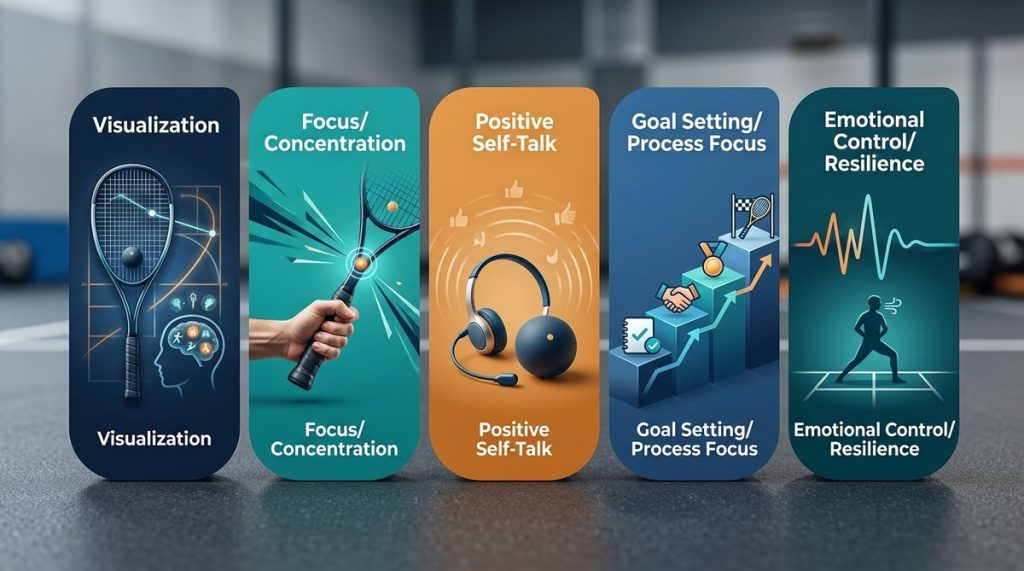
This article presents five practical mental exercises that amateur and competitive squash players can use to sharpen focus, manage pressure, and improve on-court decision making. Each technique is backed by sport psychology principles and adapted for squash. You will learn how to quiet negative thoughts, stay present during rallies, and build unshakeable confidence before your next match.
The Pre-Match Visualisation Routine
Your mind influences your body before the first serve is even struck. Top PSA players use visualisation to rehearse perfect shots, anticipate opponent patterns, and calm nerves. Here is how you can do the same.
Find a quiet spot ten minutes before your match. Close your eyes. Picture the court. See the white lines, the red tin, the blue back wall. Now imagine yourself playing. See your serve landing deep in the back corner. Watch your opponent struggle to return. Feel the racket in your hand, the sound of the ball hitting the strings.
Do not just see it. Feel it. Feel the air on your skin. Hear the bounce. The more sensory detail you include, the stronger the neural pathway becomes. Research shows that visualisation activates the same brain regions as actual physical practice. Your brain cannot tell the difference between a vividly imagined movement and a real one.
Make visualisation a habit. Do it before every match, even in training. Many club players skip this step because it feels awkward at first. Stick with it. After a few weeks, you will notice a real shift in how prepared you feel.
For a deeper look at how the pros manage pressure, read our article on meet the mental game: how top PSA pros stay cool under pressure.
The Breath Anchor for Tight Rallies
Squash rallies are short, intense, and full of decisions. Your heart rate spikes, your breathing becomes shallow, and your focus narrows. That is exactly when mental errors happen. You hit the tin. You misjudge the length. You forget the game plan.
The breath anchor is a simple technique that brings you back to the present moment. Here is the process.
- Between every point, take one slow breath in through your nose for a count of four.
- Hold the breath for a count of two.
- Exhale through your mouth for a count of six.
- As you exhale, let your shoulders drop and soften your grip on the racket.
That is it. One breath. Do not skip it. Even if you just lost a point, run this breath anchor before you turn to receive the serve. It breaks the cycle of negative thinking and resets your nervous system.
I teach this to players at every level. I have seen it turn around matches that looked lost. The key is consistency. Make this breath the first thing you do after every rally, win or lose. Eventually it becomes automatic.
Blockquote: “The moment between points is the most valuable real estate in squash. Your opponent is recovering physically. You recover mentally. The breath anchor gives you that edge.” — Sarah-Jane Perry, former PSA World No.4
The One-Second Reset After Mistakes
Mistakes happen. You hit a boast that clips the tin. You misread the angle. You serve badly. The natural reaction is frustration, self-criticism, and a cascade of negative thoughts. That leads to more mistakes and a downward spiral.
The one-second reset is a mental exercise for squash that stops the spiral before it starts.
As soon as you make an error, do the following:
– Acknowledge the mistake with a neutral word like “clear” or “next”.
– Tap the side of your racket head with your opposite hand as a physical trigger.
– Move your eyes to the front wall and see the next point in your mind.
– All of this takes less than one second.
The key is to avoid judging the mistake. Do not think about why you hit the tin. Do not replay the shot. Just reset. You can analyse the mistake after the match. During the match, your job is to stay present and focused on the next point.
This technique is used by many top tennis players and it translates perfectly to squash. I have seen club players drop from three unforced errors per game to one just by adopting the one-second reset.
If you find yourself constantly falling behind early in games, our guide on how to exploit your opponent’s weaknesses in the first three points complements this mental reset perfectly.
Cue Words for Shot Selection
Squash is a game of patterns. When you are tired or under pressure, you default to muscle memory. That can be good if your technique is correct, but bad if you default to lazy habits.
Cue words are short, powerful phrases that trigger the right technical or tactical response. For example:
- “Length” reminds you to hit deep and give your opponent no angles.
- “Soft” reminds you to take pace off a drop shot.
- “Step” reminds you to move your feet before swinging.
Choose two or three cue words that address your weakest areas. Write them on your racket handle with a marker. During the match, after the breath anchor, say the cue word silently to yourself before the rally begins.
The science behind cue words is simple. They cut through mental chatter and activate the correct motor program. Instead of thinking “I need to remember to hit it deep”, you just think “Length”. The word primes your body automatically.
Here is a table of common squash situations and the cue word that works best.
| Situation | Common Mistake | Effective Cue Word |
|---|---|---|
| After winning a rally | Relaxing too soon, playing loose | “Ready” |
| Opponent is pressuring the T | Hitting weak crosscourts | “Boast” or “Lob” |
| You are stuck in the back corner | Trying a risky winner | “Length” |
| Drop shot opportunity | Overhitting into the tin | “Soft” |
| After losing three points in a row | Rushing decisions | “Breathe” |
Implementing cue words takes discipline. Start with just one cue word for an entire practice session. Once it feels natural, add a second. Over time, these words become your internal coach.
For more detail on reading opponents and making better decisions mid-rally, check out reading the game: 7 visual cues that telegraph your opponent’s next shot.
The Pre-Serve Ritual for Consistency
The serve is the only shot you fully control. Yet many club players rush it. They bounce the ball once, glance at the opponent, and hit. That lack of ritual invites inconsistency.
A pre-serve ritual is a sequence of physical and mental actions that you repeat before every serve. It builds consistency, blocks distractions, and signals to your brain that it is time to execute.
Here is a sample ritual you can adapt:
- Stand behind the service box.
- Take one deep breath (the breath anchor).
- Visualise the serve landing exactly where you want it, deep to the backhand corner.
- Bounce the ball three times.
- Step into the box and serve.
Your ritual can be different. The key is repetition. Do the same thing every time. Do not let fatigue, crowd noise, or the score change your routine.
Many professional players have highly specific rituals. They know that a consistent mental process leads to a consistent physical outcome. For an amateur player, a simple three-step ritual can improve serve accuracy by a significant margin.
If you want to turn your serve into a real weapon, read our article on make your serve a weapon by targeting the four back corners.
Using the T as a Mental Anchor
The T is the most important area on the court. It is where you recover after every shot. It is also where you can reset mentally.
During a rally, your attention should shift between the ball, your opponent, and the space on court. But when you reach the T, that is your moment to refocus.
Here is a simple mental exercise to use at the T.
- When you arrive at the T, feel the floor under your feet.
- Take a half breath.
- Say your cue word for the situation (for example, “watch” if you expect a crosscourt).
- Move your eyes to the ball and prepare for the next shot.
This exercise keeps you from drifting mentally. Instead of thinking about the score or the last shot, you stay locked into the rally. It also helps with movement. Many players arrive at the T and stop moving. The mental anchor reminds you to stay on your toes.
Combine this with physical training on the T. Our guide on are you making these 7 footwork mistakes on the T? will help you perfect your movement there.
Train Your Mind, Transform Your Game
These five mental exercises for squash will not make you perfect overnight. But if you commit to practising them, you will notice a real difference in your focus, confidence, and ability to handle pressure.
Start with one exercise. The breath anchor is the easiest to implement because you can do it in your next match without any preparation. Once that becomes habit, add the one-second reset. Then introduce visualisation before your next training session.
Your mind is a muscle. Train it with the same dedication you give to your ghosting drills and length practice. Over time, the mental side of squash will become your greatest strength, not your biggest weakness.
Now go and play. Use the breath anchor before your next serve. Reset after a mistake. Choose a cue word for that weak shot you keep hitting. And remember: every point is a new opportunity. The only thing standing between you and a better performance is the six inches between your ears.“`markdown
You step onto court for the fifth game, level at two games apiece. Your legs feel heavy, but that is not the real problem. The real problem is the noise in your head. The voice that says you are going to lose. The fear of missing the next drop shot. The memory of that tin you hit last game. Every squash player knows this moment. The difference between winning and losing often comes down to one thing: how well you control your mind.
Physical training gets all the attention, yet the mental side of squash is what separates good players from great ones. Professionals like Mohamed ElShorbagy and Paul Coll do not just prepare their bodies. They train their brains with specific mental exercises for squash. And you can too.
This article presents five practical mental exercises that amateur and competitive squash players can use to sharpen focus, manage pressure, and improve on-court decision making. Each technique is backed by sport psychology principles and adapted for squash. You will learn how to quiet negative thoughts, stay present during rallies, and build unshakeable confidence before your next match.
The Pre-Match Visualisation Routine
Your mind influences your body before the first serve is even struck. Top PSA players use visualisation to rehearse perfect shots, anticipate opponent patterns, and calm nerves. Here is how you can do the same.
Find a quiet spot ten minutes before your match. Close your eyes. Picture the court. See the white lines, the red tin, the blue back wall. Now imagine yourself playing. See your serve landing deep in the back corner. Watch your opponent struggle to return. Feel the racket in your hand, the sound of the ball hitting the strings.
Do not just see it. Feel it. Feel the air on your skin. Hear the bounce. The more sensory detail you include, the stronger the neural pathway becomes. Research shows that visualisation activates the same brain regions as actual physical practice. Your brain cannot tell the difference between a vividly imagined movement and a real one.
Make visualisation a habit. Do it before every match, even in training. Many club players skip this step because it feels awkward at first. Stick with it. After a few weeks, you will notice a real shift in how prepared you feel.
For a deeper look at how the pros manage pressure, read our article on meet the mental game: how top PSA pros stay cool under pressure.
The Breath Anchor for Tight Rallies
Squash rallies are short, intense, and full of decisions. Your heart rate spikes, your breathing becomes shallow, and your focus narrows. That is exactly when mental errors happen. You hit the tin. You misjudge the length. You forget the game plan.
The breath anchor is a simple technique that brings you back to the present moment. Here is the process.
- Between every point, take one slow breath in through your nose for a count of four.
- Hold the breath for a count of two.
- Exhale through your mouth for a count of six.
- As you exhale, let your shoulders drop and soften your grip on the racket.
That is it. One breath. Do not skip it. Even if you just lost a point, run this breath anchor before you turn to receive the serve. It breaks the cycle of negative thinking and resets your nervous system.
I teach this to players at every level. I have seen it turn around matches that looked lost. The key is consistency. Make this breath the first thing you do after every rally, win or lose. Eventually it becomes automatic.
Blockquote: “The moment between points is the most valuable real estate in squash. Your opponent is recovering physically. You recover mentally. The breath anchor gives you that edge.” — Sarah-Jane Perry, former PSA World No.4
The One-Second Reset After Mistakes
Mistakes happen. You hit a boast that clips the tin. You misread the angle. You serve badly. The natural reaction is frustration, self-criticism, and a cascade of negative thoughts. That leads to more mistakes and a downward spiral.
The one-second reset is a mental exercise for squash that stops the spiral before it starts.
As soon as you make an error, do the following:
– Acknowledge the mistake with a neutral word like “clear” or “next”.
– Tap the side of your racket head with your opposite hand as a physical trigger.
– Move your eyes to the front wall and see the next point in your mind.
– All of this takes less than one second.
The key is to avoid judging the mistake. Do not think about why you hit the tin. Do not replay the shot. Just reset. You can analyse the mistake after the match. During the match, your job is to stay present and focused on the next point.
This technique is used by many top tennis players and it translates perfectly to squash. I have seen club players drop from three unforced errors per game to one just by adopting the one-second reset.
If you find yourself constantly falling behind early in games, our guide on how to exploit your opponent’s weaknesses in the first three points complements this mental reset perfectly.
Cue Words for Shot Selection
Squash is a game of patterns. When you are tired or under pressure, you default to muscle memory. That can be good if your technique is correct, but bad if you default to lazy habits.
Cue words are short, powerful phrases that trigger the right technical or tactical response. For example:
- “Length” reminds you to hit deep and give your opponent no angles.
- “Soft” reminds you to take pace off a drop shot.
- “Step” reminds you to move your feet before swinging.
Choose two or three cue words that address your weakest areas. Write them on your racket handle with a marker. During the match, after the breath anchor, say the cue word silently to yourself before the rally begins.
The science behind cue words is simple. They cut through mental chatter and activate the correct motor program. Instead of thinking “I need to remember to hit it deep”, you just think “Length”. The word primes your body automatically.
Here is a table of common squash situations and the cue word that works best.
| Situation | Common Mistake | Effective Cue Word |
|---|---|---|
| After winning a rally | Relaxing too soon, playing loose | “Ready” |
| Opponent is pressuring the T | Hitting weak crosscourts | “Boast” or “Lob” |
| You are stuck in the back corner | Trying a risky winner | “Length” |
| Drop shot opportunity | Overhitting into the tin | “Soft” |
| After losing three points in a row | Rushing decisions | “Breathe” |
Implementing cue words takes discipline. Start with just one cue word for an entire practice session. Once it feels natural, add a second. Over time, these words become your internal coach.
For more detail on reading opponents and making better decisions mid-rally, check out reading the game: 7 visual cues that telegraph your opponent’s next shot.
The Pre-Serve Ritual for Consistency
The serve is the only shot you fully control. Yet many club players rush it. They bounce the ball once, glance at the opponent, and hit. That lack of ritual invites inconsistency.
A pre-serve ritual is a sequence of physical and mental actions that you repeat before every serve. It builds consistency, blocks distractions, and signals to your brain that it is time to execute.
Here is a sample ritual you can adapt:
- Stand behind the service box.
- Take one deep breath (the breath anchor).
- Visualise the serve landing exactly where you want it, deep to the backhand corner.
- Bounce the ball three times.
- Step into the box and serve.
Your ritual can be different. The key is repetition. Do the same thing every time. Do not let fatigue, crowd noise, or the score change your routine.
Many professional players have highly specific rituals. They know that a consistent mental process leads to a consistent physical outcome. For an amateur player, a simple three-step ritual can improve serve accuracy by a significant margin.
If you want to turn your serve into a real weapon, read our article on make your serve a weapon by targeting the four back corners.
Using the T as a Mental Anchor
The T is the most important area on the court. It is where you recover after every shot. It is also where you can reset mentally.
During a rally, your attention should shift between the ball, your opponent, and the space on court. But when you reach the T, that is your moment to refocus.
Here is a simple mental exercise to use at the T.
- When you arrive at the T, feel the floor under your feet.
- Take a half breath.
- Say your cue word for the situation (for example, “watch” if you expect a crosscourt).
- Move your eyes to the ball and prepare for the next shot.
This exercise keeps you from drifting mentally. Instead of thinking about the score or the last shot, you stay locked into the rally. It also helps with movement. Many players arrive at the T and stop moving. The mental anchor reminds you to stay on your toes.
Combine this with physical training on the T. Our guide on are you making these 7 footwork mistakes on the T? will help you perfect your movement there.
Train Your Mind, Transform Your Game
These five mental exercises for squash will not make you perfect overnight. But if you commit to practising them, you will notice a real difference in your focus, confidence, and ability to handle pressure.
Start with one exercise. The breath anchor is the easiest to implement because you can do it in your next match without any preparation. Once that becomes habit, add the one-second reset. Then introduce visualisation before your next training session.
Your mind is a muscle. Train it with the same dedication you give to your ghosting drills and length practice. Over time, the mental side of squash will become your greatest strength, not your biggest weakness.
Now go and play. Use the breath anchor before your next serve. Reset after a mistake. Choose a cue word for that weak shot you keep hitting. And remember: every point is a new opportunity. The only thing standing between you and a better performance is the six inches between your ears.