How to Master the Squash Overhead Smash for Power and Placement
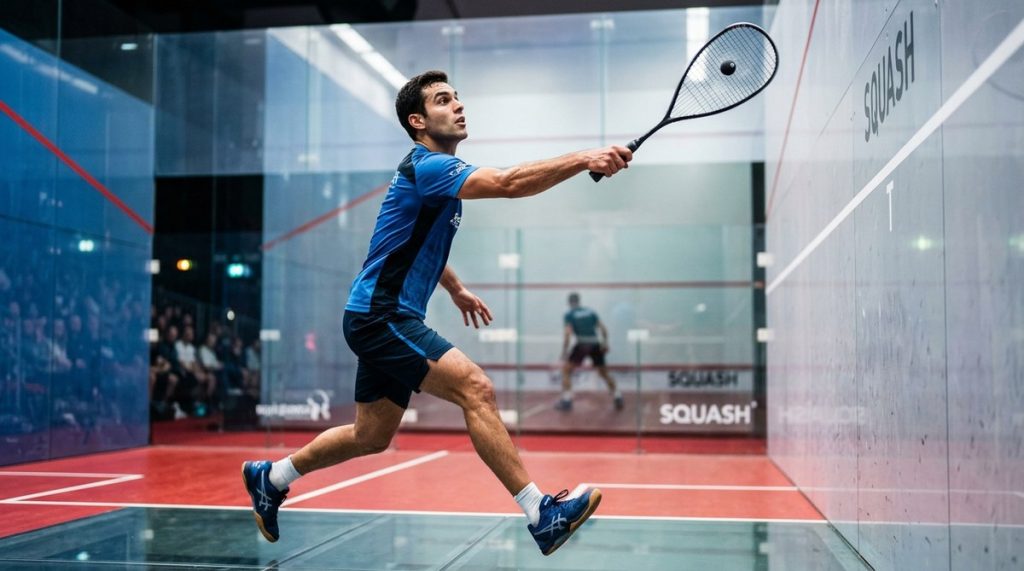
The squash overhead smash is one of the most satisfying shots in the game. When you catch one cleanly, the sound of the ball compressing off the strings, the sight of it disappearing into the front corner, the helpless shuffle of your opponent as they know they are not getting there. It is a statement shot. But too many club players treat it as a lottery. They swing hard, hope for the best, and watch the ball either hit the tin or fly loose to the middle of the court. That is not a smash. That is a gamble.
The difference between a decent club player and a dangerous one is often the ability to finish points from above the shoulder. The overhead smash is your highest percentage winner when done correctly. It does not require freakish strength or a 6-foot-4 frame. It requires technique, timing, and the right tactical thinking. Let us break down exactly how to build a squash overhead smash that wins you points, not rallies.
The squash overhead smash is not about raw power. It is about positioning your body under the ball, using a loose wrist to generate racket head speed, and choosing your target before you jump. When you combine a neutral stance with a relaxed arm and a clear target, you turn a low-percentage swing into a reliable point finisher. Master the three-step process and you will never hesitate again.
Why Most Club Players Struggle from Above the Shoulder
The overhead smash feels unnatural to many players because squash is primarily a ground-level sport. You spend most of your time hunched, lunging, and hitting balls below the knee. When a ball floats up to chest height or above, the instincts take over. You back away, you snatch at the ball, and you try to muscle it. That is where the problems start.
The most common errors include:
- Dropping the racket head behind your back instead of keeping it in a loaded position
- Stepping backward instead of forward into the shot
- Swinging with a straight arm and a locked wrist, losing all whip
- Trying to hit through the ball rather than catching it slightly in front
- Aiming too early and telegraphing the shot to your opponent
These issues all stem from one root cause. You are treating the overhead smash like a tennis serve. It is not. In tennis, you have time to coil, toss, and unload. In squash, the ball is coming off the front wall and you have a fraction of a second to decide and execute. The mechanics need to be compact, efficient, and repeatable.
The Three-Step Process for a Reliable Smash
If you want to add the squash overhead smash to your weapon list, follow this sequence. It works on both forehand and backhand sides, though the backhand smash requires a slightly different wrist position.
1. Get your feet right before the ball arrives
Move to the ball early. Do not wait to see where it lands. Read the trajectory off the front wall and shuffle into position so the ball lands just behind your front foot. Your weight should be moving forward, not backward. The most common mistake is backpedalling. If your momentum is moving away from the front wall, you will lose power and control.
2. Load the racket with a relaxed wrist
Bring the racket up behind your head with your elbow bent and your wrist loose. Your non-racket hand should point up toward the ball for balance. Think of your arm as a whip. The power comes from the snap of the wrist, not from your shoulder muscles. If your wrist is rigid, you lose acceleration at the point of contact.
3. Contact the ball slightly in front of your body
This is the most important detail. Hit the ball when it is just ahead of your front shoulder, not directly above your head. Contact too far back and you lose power. Contact too far forward and you hit down into the tin. The sweet spot is roughly 30 centimetres in front of your body at full extension. Aim to catch the ball at the highest point you can reach comfortably.
From here, a short, sharp follow-through completes the shot. Your racket should finish down across your body, not wrapped around your neck.
Choosing Your Target: Power versus Placement
Not every overhead smash needs to be a winner. Sometimes the smart play is to hit a high, deep smash that pins your opponent in the back corner. Other times you want to put the ball into the nick and end the rally.
Here is a simple decision framework to use during a match:
| Situation | Recommended Target | Why |
|---|---|---|
| Opponent is mid-court and off balance | Front corner, low and tight | Quick winner, they cannot recover |
| Opponent is deep in the back corner | Cross-court smash to opposite deep corner | Maximises court distance, gives you time to recover to the T |
| Ball is very high and you have plenty of time | Front court nick or short side wall boast | Highest percentage finish if executed cleanly |
| You are slightly off balance or late to the ball | High, deep drive to the back of the court | Safe option that keeps pressure on without risking a tin |
| Opponent is crowding the T and leaning forward | Sharp, tight smash down the near side wall | Catches them moving the wrong way |
The table above is a cheat sheet for your decision-making. Memorise it during practice so it becomes automatic in a match. The best players do not think about where to hit. They have already decided before the ball bounces.
“The overhead smash is not about how hard you hit it. It is about how early you get into position. If you are late, you cannot recover. If you are early, you can do anything with the ball.” — A PSA coach once told me this during a clinic, and it has stuck with me ever since.
The Backhand Smash: The Missing Weapon
Most club players have a decent forehand smash but struggle on the backhand side. The backhand overhead feels weaker, less controlled, and often ends up as a lob or a weak drop.
The secret to the backhand smash is wrist snap and body rotation. Here is how to fix it:
- Turn your shoulders so your back is almost facing the front wall
- Keep your elbow high and your racket head pointing behind you
- As the ball arrives, rotate your hips and shoulders toward the front wall
- Snap your wrist at the last moment to generate racket head speed
- Follow through low and across your body
The backhand smash will never feel as natural as the forehand. But with regular practice, it becomes a reliable tool. Start by hitting fifty backhand smashes per training session. Focus on form, not power. The speed will come.
If you want to improve your movement to the ball, read this guide on Getting into position earlier is half the battle.
Common Mistakes and How to Fix Them
Let us look at the four most frequent mistakes club players make with the squash overhead smash and the specific corrections.
-
Mistake: Swinging too hard and losing control. The fix is simple. Reduce your swing speed by 20 percent and focus on a clean contact point. You will actually gain power because you are hitting the sweet spot more often.
-
Mistake: Keeping the wrist locked. The fix is to consciously relax your grip just before you swing. A looser grip allows the wrist to hinge naturally. Think of holding a tube of toothpaste. Tight enough to keep it from falling, loose enough to squeeze it.
-
Mistake: Jumping off both feet (stuck in the air). The fix is to use a one-foot takeoff, usually your back foot. This keeps your body moving forward and allows you to land and recover faster.
-
Mistake: Aiming too early and tipping off your opponent. The fix is to keep your racket head hidden until the last moment. Use the same preparation for a smash, a drive, or a drop. This is part of the art of deception, which ties into
Building Power Through Body Mechanics
Power in the squash overhead smash does not come from arm strength. It comes from a chain of movements that start in your legs.
Follow this sequence:
- Bend your knees as you approach the ball. A deep knee bend stores energy like a compressed spring.
- Rotate your hips and shoulders away from the front wall during the loading phase.
- As you jump or step into the shot, uncoil your hips first, then your torso, then your shoulder.
- Let your arm follow the body rotation. The racket head should lag behind until the last moment.
- Snap your wrist at contact. This final flick adds the majority of your racket head speed.
If you want to develop more explosive power for all your shots, have a look at The same principles apply to drives, kills, and smashes alike.
When Not to Hit the Overhead Smash
Knowing when not to hit the smash is just as important as knowing when to use it. Here are three situations where you should hold back:
- The ball is too low. If it drops below your shoulder height, you cannot generate the downward angle needed for a clean smash. Play a drive or a drop instead.
- You are off balance. If you are reaching, stretching, or falling away from the ball, the smash is a low-percentage shot. Take the safe option and reset the rally.
- You are too close to the front wall. If you are inside the service box, the ball is too close to the tin for a full swing. A soft volley drop or a lob is a better choice.
Discipline is the mark of an advanced player. The best in the world do not try to hit a winner from every opportunity. They pick their moments and execute with precision.
Practising the Smash Without a Partner
You do not need a training partner to improve your overhead smash. Solo practice is highly effective if you use the right drill.
The self-feed smash drill:
- Stand at the back of the court with a bucket of balls
- Toss a ball high and slightly forward so it bounces near the back wall
- As it rises, step forward, load your racket, and hit a smash down the side wall
- Aim for a target area near the front corner
- Repeat twenty times on the forehand side, then twenty on the backhand
This drill builds muscle memory and confidence. It also helps you find the exact contact point that works for your height and reach.
For more solo exercises, check out It includes several drills that complement your smash practice.
Putting It All Together in a Match
You can practice the squash overhead smash for hours, but the real test comes during a match. Nerves, fatigue, and pressure change everything. Here is how to carry your practice form into competitive play.
Start your match by using the smash only when you are in perfect position. Build confidence with two or three easy winners early on. Once you feel the rhythm, you can start using it in tougher situations. Your brain needs to associate the smash with success, not failure.
If you miss one, do not abandon the shot. Analyse what went wrong. Were you too late? Did you aim too fine? Make a small adjustment and try again. The players who dominate the front court are the ones who trust their shots even after a mistake.
For more on reading your opponent and choosing the right moment to attack, read It will sharpen your decision-making.
From Power to Precision: Your Next Step
The squash overhead smash is a weapon that separates competitors from participants. When you can finish a point cleanly from above the shoulder, you force your opponent to respect that part of the court. They start standing deeper. They start second-guessing their own lobs. You gain control without swinging harder.
Start with the three-step process. Get your feet right, load the racket with a relaxed wrist, and contact the ball slightly in front of your body. Then layer in the target selection. Use the table to make smarter decisions. And do not neglect the backhand side. It is the weaker link for most players, which means it is also your biggest opportunity for improvement.
Spend ten minutes at the end of your next training session on the self-feed smash drill. Fifty reps, split between forehand and backhand. After two weeks, you will notice a difference. After a month, the overhead smash will feel like a natural part of your game rather than a hopeful swing.
The court is waiting. Get out there and start smashing with purpose.