The Art of Video Analysis: Using Technology to Accelerate Player Development
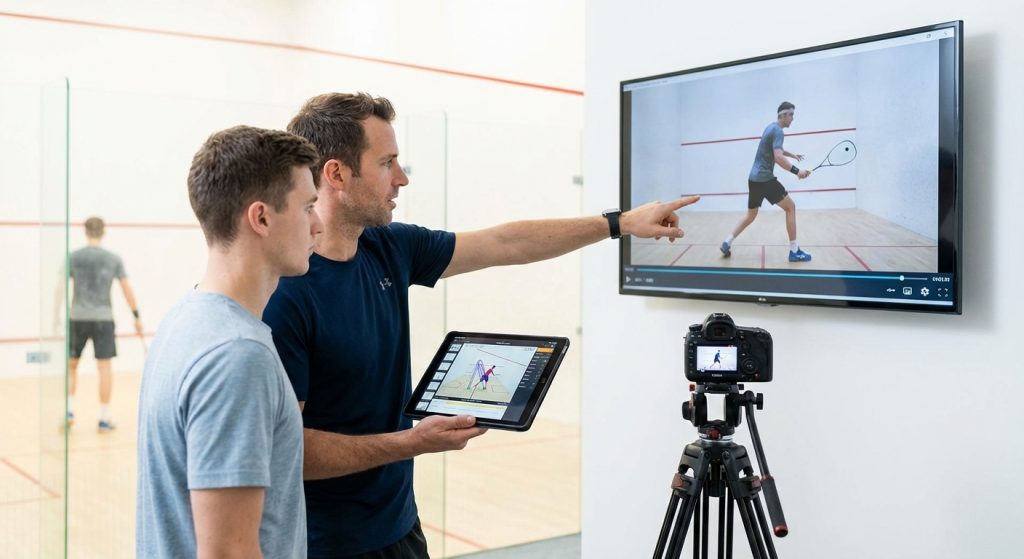
Video technology has transformed how coaches teach squash. What once required years of court time and instinct can now be accelerated through systematic video analysis. Players see their mistakes instantly. Coaches communicate corrections with precision. Development speeds up.
Video analysis player development combines recording technology with structured feedback frameworks to accelerate skill acquisition. Coaches who implement systematic video review sessions help players identify technical flaws, understand tactical patterns, and track measurable progress over time. The most effective programmes blend immediate post-session reviews with periodic long-term comparisons to maintain motivation and demonstrate tangible improvement in court movement, shot execution, and strategic decision-making.
Why Traditional Coaching Methods Miss Critical Details
Human observation has limits. A coach watches a player hit a forehand drive and spots the obvious errors. Late preparation. Poor footwork. Weak follow-through.
But what about the subtle rotation of the hips? The exact angle of the racket face at contact? The precise timing between the split step and the first movement?
These micro-movements separate good players from great ones. They’re nearly impossible to catch in real time.
Video captures everything. Frame by frame. Angle by angle. You can pause, rewind, and zoom in on the exact moment a technical flaw appears. Players finally see what you’ve been telling them for weeks.
The evidence becomes undeniable.
The Science Behind Visual Learning in Sport

Athletes retain information differently when they see themselves perform. Research in motor learning shows that visual feedback accelerates skill acquisition by 40% compared to verbal instruction alone.
Your brain processes visual information 60,000 times faster than text. When a player watches their own swing, neural pathways activate differently than when they simply hear corrections. They build a mental model of correct technique faster.
This matters particularly for squash, where movements happen at extreme speed. A volley takes less than half a second from preparation to contact. No player can consciously process every element during live play.
But they can study it afterwards. Repeatedly. Until the correct pattern becomes automatic.
Setting Up Your Video Analysis System
You don’t need expensive broadcast equipment. A smartphone on a tripod works perfectly for most coaching situations.
Here’s what you actually need:
- A recording device with at least 1080p resolution and 60 frames per second capability
- A tripod or stable mounting position that captures the full court
- Adequate lighting to avoid shadows and motion blur
- Video analysis software or apps designed for sports coaching
- A tablet or laptop for immediate review sessions with players
- Cloud storage or external drives for archiving footage long-term
Position your camera at mid-court height, slightly behind the back wall. This angle captures both players, the entire court, and shows shot trajectories clearly. For detailed technical work on specific strokes, add a second camera positioned side-on to capture body rotation and weight transfer.
Most coaches start with just one camera. That’s enough to generate significant improvements.
The Five-Step Video Review Process
Structure matters. Random video watching wastes time. Follow this framework for every review session:
1. Watch once without commentary
Let the player observe their entire rally or drill sequence. No interruptions. They’ll spot many errors themselves before you say anything. This builds self-awareness and reduces defensiveness.
2. Identify one primary focus area
Don’t overwhelm players with ten corrections at once. Pick the single most impactful improvement. Usually, this means addressing footwork before stroke mechanics, since movement affects everything else.
3. Compare with model footage
Show professional players or previous footage of the same player performing correctly. The contrast makes the correction obvious. When reviewing footwork patterns, side-by-side comparison reveals exactly where positioning breaks down.
4. Create specific action points
Vague advice like “move better” achieves nothing. Instead: “Split step half a second earlier when your opponent shapes for the drive.” Specific, measurable, actionable.
5. Record the next attempt immediately
Capture the correction in action whilst the feedback is fresh. This creates a progress archive and reinforces the improvement through immediate visual confirmation.
The best coaches I’ve worked with never review more than three elements per session. They pick one critical flaw, fix it through video evidence, then move on. Trying to correct everything at once just confuses players and slows development.
Common Technical Flaws Video Analysis Reveals
Certain mistakes appear repeatedly across all levels. Video makes them impossible to ignore.
| Technical Flaw | What Video Shows | Typical Cause |
|---|---|---|
| Late racket preparation | Backswing starts after opponent hits | Poor anticipation or lazy movement |
| Incorrect weight transfer | Back foot remains planted through contact | Fear of commitment or weak legs |
| Abbreviated follow-through | Swing stops immediately after contact | Tension or rushing to recover |
| Poor court positioning | Standing too far from the T | Fatigue or tactical misunderstanding |
| Inconsistent grip changes | Same grip used for multiple shot types | Lack of awareness or technical training |
| Minimal shoulder rotation | Upper body remains square to front wall | Stiffness or incomplete swing mechanics |
These patterns become obvious when you watch footage with players. They see the evidence and accept corrections more readily than when you simply tell them what’s wrong.
Tactical Analysis Through Match Footage
Technical work forms the foundation. Tactical analysis wins matches.
Record full match footage and study decision-making patterns. Where does your player consistently choose the wrong shot? When do they attack too early? Why do they struggle against certain playing styles?
Video reveals tactical tendencies players don’t recognize themselves. One junior I coached thought he varied his shots well. The footage showed he hit 78% of his shots straight. His opponent simply camped on the straight line and intercepted everything.
The numbers don’t lie.
Mark up footage with notation software. Highlight every attacking opportunity missed. Circle moments where court position was sacrificed unnecessarily. Track how often the T is held versus given away.
These patterns emerge clearly over multiple matches. You’ll spot exploitable weaknesses in opponents too. When preparing for important matches, study footage of the upcoming opponent and identify their habits. Do they favour crosscourt under pressure? Do they struggle with pace changes? Does their movement deteriorate in long rallies?
Professional players like those featured in PSA tour analysis spend hours studying opponents before major tournaments. Club coaches can implement the same approach with minimal equipment.
Building a Video Library for Long-Term Development
The real power of video analysis appears over months and years. Archive footage systematically so you can track development over time.
Create folders organized by:
- Player name
- Date of recording
- Session type (technical drills, tactical work, match play)
- Specific focus area (forehand, movement, volleys)
Every three months, compile comparison videos showing the same drill or shot type from different dates. Players see their improvement visually. This maintains motivation during plateaus when progress feels invisible.
One player I worked with struggled with her backhand volley technique for six months. Week to week, improvements seemed minimal. But when we compared footage from month one to month six, the transformation was dramatic. Her confidence soared.
That comparison video achieved more than a hundred coaching sessions could alone.
Engaging Players Who Resist Video Analysis
Not everyone embraces video review immediately. Some players feel self-conscious or defensive watching themselves play.
Start small. Review just 30 seconds of footage in the first session. Focus exclusively on what they did well. Build comfort with the process before introducing corrections.
Make it collaborative. Ask “what do you notice here?” before offering your analysis. Players who identify their own errors accept corrections more readily than those who feel criticized.
For younger players, gamify the process. Challenge them to spot three differences between their technique and a professional’s. Award points for self-identified improvements between sessions.
The goal is making video review feel like a tool for improvement rather than a criticism session. Frame everything around progress and potential.
Technology Tools That Actually Work
Dozens of apps and software platforms claim to revolutionize coaching. Most add complexity without value. These tools genuinely help:
Free options:
– Coaches Eye (basic version): Frame-by-frame playback, drawing tools, side-by-side comparison
– Hudl Technique: Simple interface, cloud storage, easy sharing with players
– Dartfish Express: Entry-level video analysis with annotation features
Paid platforms:
– Video delay systems for immediate feedback during training
– Multi-angle recording setups for comprehensive technical analysis
– AI-powered tracking software that measures court coverage and movement patterns automatically
Start with free tools. Upgrade only when you’ve maximized their capabilities and need specific advanced features.
The software matters less than your systematic approach to reviewing footage. A smartphone and structured process beats expensive equipment used inconsistently.
Integrating Video Analysis Into Training Sessions
Video review shouldn’t exist separately from court time. Blend them together for maximum impact.
Structure sessions like this:
Minutes 0-5: Brief video review of previous session’s focus point
Minutes 5-35: Court drills addressing that specific element
Minutes 35-40: Record new footage of the drill
Minutes 40-50: Immediate review and adjustment
Minutes 50-60: Final drill set incorporating feedback
This cycle of practice, record, review, adjust creates rapid improvement. Players see corrections implemented immediately rather than waiting until next week.
For movement training, video proves particularly valuable. Players think they’re moving efficiently until they watch themselves shuffle instead of lunge, or see how much time they waste with poor recovery patterns.
Measuring Progress Through Video Metrics
Subjective improvement feels good. Measurable progress builds confidence and justifies training time.
Track specific metrics through video analysis:
- Shot accuracy percentage (target zones marked on court)
- Time from split step to first movement
- Recovery speed back to the T after each shot
- Number of attacking opportunities created per rally
- Percentage of rallies where the T is controlled
- Error rates for specific shot types
Record these numbers monthly. Graph the trends. Show players their improvement in concrete terms.
One club coach I know tracks “T control percentage” for all his players. Every month, they review match footage and calculate how often they held the T versus their opponent. This single metric improved more than any technical correction because it made tactical awareness measurable.
Avoiding Common Video Analysis Mistakes
Even experienced coaches make these errors:
Recording too much footage without reviewing it: Video only helps when watched and analyzed. Better to record less and review thoroughly than accumulate hours of unwatched footage.
Focusing exclusively on errors: Balance criticism with positive reinforcement. Show players what they’re doing well, not just what needs fixing.
Using video as a replacement for live coaching: Technology supplements hands-on instruction but never replaces it. The best feedback combines real-time correction with video review.
Overcomplicating the analysis: Fancy graphics and slow-motion effects impress no one if the core message gets lost. Keep reviews simple and focused.
Ignoring player input: Collaborative analysis works better than lecture-style review. Ask questions and encourage players to identify their own areas for improvement.
Neglecting privacy and consent: Always get permission before recording, especially with juniors. Never share footage publicly without explicit consent.
Creating Effective Feedback Sessions
The quality of your feedback determines whether video analysis accelerates development or wastes time.
Keep sessions short. Fifteen minutes of focused review beats an hour of unfocused watching. Player attention spans drop sharply after twenty minutes.
Use the pause button liberally. Freeze on the exact frame where an error occurs. Circle it. Highlight it. Make it impossible to miss.
Speak in concrete terms. Instead of “your swing looks wrong,” say “your racket face is 15 degrees too open at contact, which sends the ball high.” Precision matters.
End every session with a clear action plan. What will they practice before the next session? How will they know if they’ve improved? What should they focus on during matches?
Write it down. Email it to them. Make the next steps explicit and unavoidable.
Advanced Applications for Elite Development
Once basic video analysis becomes routine, advanced techniques accelerate development further.
Multi-angle synchronized recording captures the same rally from three positions simultaneously. This reveals technical flaws invisible from a single viewpoint. Expensive but transformative for serious competitors.
Opponent analysis databases compile footage of upcoming competitors organized by playing style, weaknesses, and tactical tendencies. Professional-level preparation accessible to ambitious amateurs.
Biomechanical analysis software measures joint angles, force generation, and movement efficiency with scientific precision. Typically requires specialist equipment but provides unmatched technical insights.
Virtual reality training integration allows players to watch their own footage in immersive 3D, experiencing rallies from different court positions. Emerging technology with promising applications.
These advanced tools require significant investment. Only pursue them after maximizing the value of basic video analysis approaches.
Building a Culture of Video-Based Learning
The most successful programmes embed video analysis into their culture. It becomes normal practice rather than special treatment.
Encourage players to record themselves during practice. Make tablets available courtside for immediate review. Create a shared cloud folder where players can access their footage anytime.
Run monthly video analysis workshops where players review each other’s footage constructively. This builds analytical skills and creates peer accountability.
Celebrate improvements publicly. Show before-and-after comparison videos at club events. Recognition motivates continued effort and normalizes the development process.
When video analysis becomes routine rather than exceptional, players develop faster because they’re constantly learning from visual feedback rather than relying solely on feel and verbal instruction.
Making Video Analysis Work for Your Programme
Technology only helps when implemented systematically. Start small, build consistency, then expand.
Choose one training session per week to incorporate video review. Master that routine before adding more. Trying to record and review everything immediately creates overwhelm and abandonment.
Focus on one technical element at a time. Spend a month on forehand mechanics, then move to footwork, then volleys. Depth beats breadth every time.
Involve players in the process. Let them operate the camera sometimes. Encourage them to suggest what footage would help their development. Ownership increases engagement.
Track the results. Note which players improve fastest with video analysis versus traditional coaching alone. Adjust your approach based on evidence rather than assumptions.
Transforming Practice Into Performance
Video analysis player development works because it makes the invisible visible. Technical flaws you’ve described for months suddenly become obvious when players see them on screen. Tactical patterns they denied emerge undeniably in match footage.
The gap between knowing what to fix and actually seeing it disappears. Players accept corrections more readily. They practice more purposefully. Development accelerates.
Start recording your next training session. Review just five minutes of footage with your player. Focus on one specific element. Create a clear action point. Record the next attempt.
That simple cycle transforms how quickly players improve. The camera never lies, and neither does the progress it reveals.