5 Common Squash Serve Mistakes and How to Fix Them
You step onto the court, ball in hand, and the match hangs on your first shot. The serve is your only chance to control the rally from the very start, yet so many club players in the UK treat it as a mere formality. A weak, predictable serve hands your opponent the initiative before you have even moved. The good news? Most serve mistakes are easy to fix once you know what to look for. Let us walk through the five most common errors and give you practical corrections that will transform that opening shot into a weapon.
The serve is the most underrated shot in squash. Fixing five common mistakes – poor placement, lack of variety, incorrect body position, rushed preparation, and failing to recover to the T – can turn your serve from a liability into a point-winning asset. Practice each correction deliberately, and you will see immediate improvements in your match results.
## Mistake 1: Aiming for the Centre of the Back Wall
Many beginner and intermediate players serve the ball straight down the middle of the court, hoping it will bounce awkwardly. Instead, it lands perfectly for the opponent, who can step forward and volley it deep into the back corners. The serve should force the receiver to move to the backhand side, especially when serving from the right service box.
### The Fix: Aim for the Backhand Corner
Your target should be the backhand wall, roughly halfway up and close to the side wall. A good serve will hit the side wall first, then travel parallel to the back wall before dying in the backhand corner. This makes the receiver stretch and often forces a weak return.
Here is a simple process to practise this:
1. Stand in the centre of the service box.
2. Point your front foot towards the backhand corner of the opposite service box.
3. Use a smooth, controlled swing – think placement over power.
4. Aim to hit the side wall about 45–60 cm above the floor.
5. Watch the ball travel along the back wall before it dies.
Practise this ten times from each side before your next match.
> “The serve is the one shot where you have total control. If you waste it on a loose ball, you are letting your opponent off the hook. Aim for the backhand corner every time, and you will start dictating points from the first hit.” – Veteran coach from the English Squash Academy
## Mistake 2: No Variation in Serve Type
If you always serve the same pace, height, and spin, your opponent will read you like a book. They will move early, volley your serve, and put you under pressure. Variation keeps them guessing and disrupts their rhythm.
### The Fix: Add a Lob Serve and a Body Serve
Mix in a high lob serve that forces the receiver deep behind the service box, or a flat, driven serve that targets their body. A lob serve gives you time to recover to the T, while a body serve can jam the receiver and produce a loose return.
– **Lob serve**: toss the ball higher, hit it with a more vertical racket face, and aim for the backhand corner with extra height.
– **Body serve**: aim straight at the receiver’s hip or shoulder so they have to adjust their racket position.
Use this table to compare the three main serve types:
| Serve Type | Target Area | Effect on Receiver | When to Use |
|————|————-|——————–|————-|
| Basic lob | Backhand corner, high | Forces them deep, slow return | When you need time to recover |
| Flat drive | Backhand corner, low | Tests movement, can produce weak boast | Against a slow mover |
| Body serve | Mid-body (hip/shoulder) | Jams racket, forces defensive block | To break rhythm or after a timeout |
Practise each type for five minutes during warm-up. Your goal is to have three distinct serves you can call on during a match.
## Mistake 3: Standing Too Square to the Front Wall
When you serve, your feet should be angled towards your target, not facing the front wall. Many players stand square, which limits hip rotation and forces them to slap at the ball. This leads to inconsistent contact and poor accuracy.
### The Fix: Open Your Stance
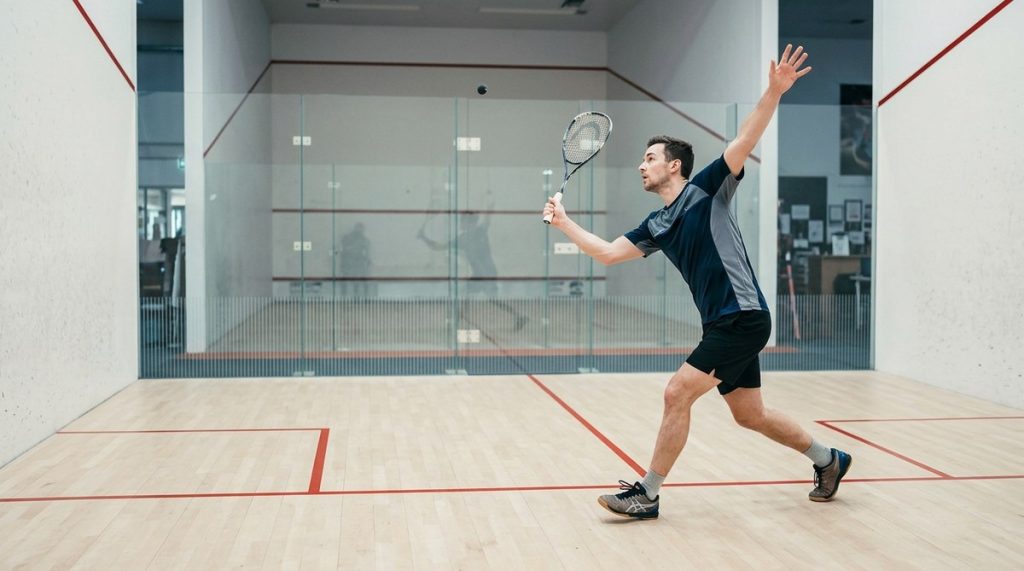
Position your front foot (left foot for right-handers) pointing towards the backhand corner of the opposite service box. Your back foot should be roughly parallel to the side wall. This open stance allows your hips to rotate naturally and gives you a clearer line to the target.
A common drill is to practise the serve without the ball first. Go through the motion, feel the hip turn, and check your foot alignment. Then add the ball. After a few sessions it will become automatic. For more on building consistent technique, read our guide on [refining your squash technique for consistent power and accuracy](https://squashsite.today/refining-your-squash-technique-for-consistent-power-and-accuracy/).
## Mistake 4: Rushing the Serve Preparation
In match pressure, players often rush through the service routine. They bounce the ball once, toss it up sloppily, and swing before they have set their feet. The result? A serve that is either too high, too low, or mis-hit entirely.
### The Fix: Build a Pre-Serve Routine
A consistent routine calms your nerves and ensures every serve starts from the same position. Follow these steps:
1. Stand behind the service line and take a deep breath.
2. Bounce the ball twice to establish rhythm.
3. Look at your target (the backhand corner).
4. Step into the service box with your front foot pointing at the target.
5. Pause for half a second.
6. Toss the ball and execute.
This may feel slow at first, but it prevents rushed mistakes. Top PSA players all have a deliberate routine. Adopt one, and your accuracy will jump. For match-day preparation tips, see our article on [pre-match warm-up routines from the PSA tour](https://squashsite.today/pre-match-warm-up-routines-from-the-psa-tour/).
## Mistake 5: Forgetting to Recover to the T
After hitting your serve, many players stand and watch it. They admire the bouncing ball and only start moving once the receiver has struck it. By then they are already out of position. The T is where you need to be to cover the full court.
### The Fix: Make Recovery Part of the Serve
As soon as you release the racket head, push off your back foot and head straight for the T. Do not wait to see where the ball lands. Your serve should dictate the rally, but only if you are ready to respond.
– **Visual cue**: Imagine a string pulling you from the T. The moment your racket finishes, you are pulled there.
– **Drill**: Serve five balls in a row, each time sprint to the T and set your split step. Pause, then serve again.
This habit alone will win you extra points because you will intercept more returns. For a deeper look at footwork and positioning, check our post on [why your court positioning is costing you matches (and how to fix it)](https://squashsite.today/why-your-court-positioning-is-costing-you-matches-and-how-to-fix-it/).
## Turning Your Serve into a Game Changer
These five mistakes are the ones we see most often on club courts across the UK. A poor serve gives away cheap points. A good serve sets up the rally on your terms. And a great serve can win points outright, especially against players who struggle to move backwards quickly.
Start by picking just one mistake from this list. Focus on it for a week. Use solo practice to drill the correct technique, then test it in your next match. Once it feels natural, move on to the next. Over a few months, your serve will evolve from a weakness into a strength.
Remember: squash is a game of small margins. A few extra points per game from a better serve can swing a whole match. So next time you step on court, take a moment, aim for the backhand corner, and own that first shot. Your opponent will thank you – or more likely, they won’t, because they will be too busy chasing the ball.