Squash Court Etiquette and Match Conduct for Club and Tournament Play
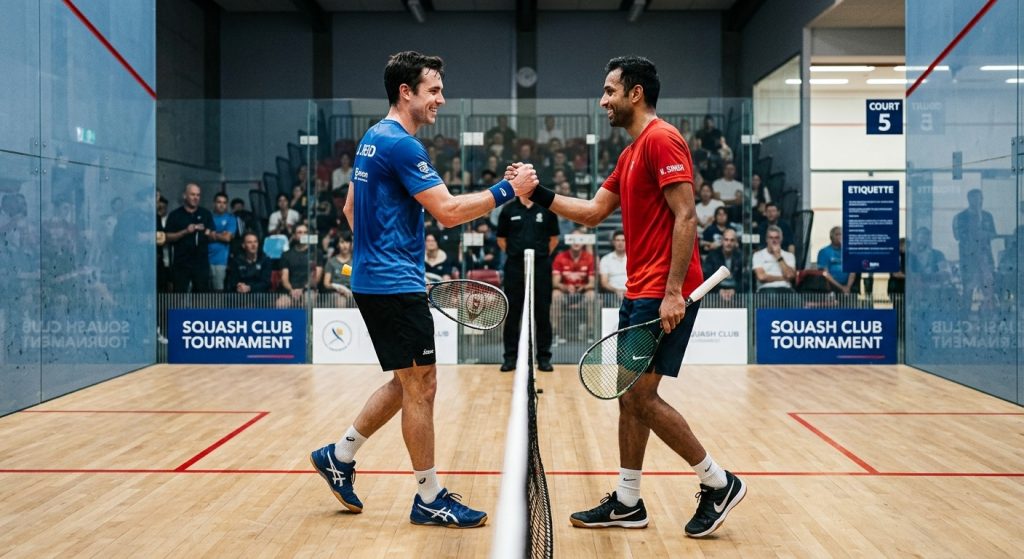
The squash court is one of the few places in sport where two competitors share exactly the same space, switching positions at speed, with no referee standing between them on every single point. That specific dynamic creates a set of conduct expectations unlike almost any other game. Get them right and matches flow cleanly. Get them wrong and a friendly club fixture turns tense inside three rallies.
Court Conduct: Key Points
- A let requires genuine obstruction; always ask with a calm “let, please” rather than asserting
- Strokes are awarded when poor positioning actively prevents an opponent from playing a fair shot
- Slowing the pace between rallies beyond the permitted time is gamesmanship that officials notice
- Tournament fixtures carry formal timing and conduct rules that casual knock-ups never enforce
- Knowing these rules before your first club event removes anxiety and lets you focus on your game
What a Let Call Means and When to Use It
A let is a replayed point. It is not a free pass and it is not a concession. It exists because squash is a sport where physical proximity sometimes makes a fair shot genuinely impossible, and both players need a clear mechanism for managing that without the match descending into frustration.
The correct procedure is straightforward. You stop the rally, call “let, please,” and wait for a decision. In a refereed match, the marker rules. In an unrefereed club match, your opponent makes the call. Most clubs encourage players to be generous rather than strict when the obstruction was real and obvious.
Knowing when to call a let matters as much as knowing how to call one. These are the situations where asking for a let is typically appropriate:
- Your opponent is in the direct path to the ball and you pull up to avoid a collision
- The ball strikes your opponent’s body or clothing mid-rally
- You are genuinely unsighted and cannot see the ball due to your opponent’s position
- A distraction outside the court, such as a door opening or a ball rolling in, interrupts the point
- Both players genuinely dispute whether the ball was up or down and neither is certain
What a let is not for: using it as a tactical reset because you are losing the point badly. Most experienced club players spot this pattern very quickly. Call lets only when the interference was genuine, and your reputation on court stays solid.
Stroke Calls and the Obligation to Give Access
A stroke goes one step further than a let. Rather than replaying the point, a stroke awards it outright. This happens when the obstruction was severe enough that a fair attempt at the ball was not just inconvenient but actively prevented.
The governing principle is this: after playing a shot, you are required to make every reasonable effort to give your opponent a clear path to the ball and a fair swing at it. If your positioning denies them either of those things, a stroke may be awarded against you. The standard is not perfection. It is reasonable effort and clear intent to clear the path.
Let Calls Versus Stroke Awards: The Core Differences
| Situation | Decision | Outcome |
|---|---|---|
| Opponent in path, player stops to avoid collision | Let | Rally replayed |
| Opponent makes no effort to clear, blocks swing entirely | Stroke | Point awarded to striker |
| Ball hits opponent’s body, rally was competitive | Let | Rally replayed |
| Player attempts shot, contact with opponent was unavoidable | Stroke (if swing was genuine) | Point awarded to striker |
| Distraction from outside court interrupts rally | Let | Rally replayed |
The logic is consistent once you understand it. A let protects both players from bad luck and unavoidable close quarters. A stroke penalises genuinely poor court behaviour. The distinction is intent and effort, not just proximity.
The Pace Between Rallies and Why It Signals Your Character
Here is something newer players often miss entirely. The time you take between rallies is itself a form of conduct. Competitive squash rules allow players a brief, consistent interval between points and a maximum of 90 seconds between games. That interval is not an open invitation to reset your entire game plan.
Deliberately slowing the pace is a recognised form of gamesmanship. It can break an opponent’s rhythm, frustrate their concentration, and shift momentum without a single stroke being played. Referees at club tournaments watch for this pattern. Repeated warnings can become conduct penalties, and conduct penalties cost you points and sometimes games.
The standard to aim for between rallies is practical and simple:
- Return the ball to the server promptly rather than pocketing it or bouncing it slowly
- Towel down quickly and only when genuinely needed, not after every single point
- Avoid lengthy discussions about calls unless a decision is actively being disputed
- Indicate clearly that you are ready to receive before the server begins their action
Rushing the pace in the opposite direction is equally a conduct issue. Some players push the serve before the receiver has indicated readiness, trying to capitalise on a momentary lapse in focus. The receiver has a right to be set. Both players control the tempo together. Respecting that is fundamental to fair play.
How Formalised Timing Rules Protect Integrity Across Precision Sports
Squash is not alone in building time conduct directly into its competitive rules. Any sport where turns and tempo are contested has had to formalise how those moments are governed. Without clear expectations, tempo itself becomes the arena for gamesmanship rather than the game itself.
Chess offers the clearest parallel outside of racket sports. Each player’s thinking time is strictly managed, and the behaviour expected around that management is codified in detail. Proper chess clock etiquette covers not just pressing the clock correctly but the conduct expected around transitions, disputes, and pace, principles that map directly onto squash’s own pace code. Both sports recognised early that if you leave tempo unregulated, the competition shifts from skill to psychological attrition in a way that undermines the integrity of the result.
At PSA World Tour level, conduct referees monitor inter-point timing actively. At club tournament level, the expectation mirrors the principle even if formal enforcement is lighter. Players who understand why the rule exists, rather than just what it says, apply it far more naturally under pressure.
Using the 90-Second Break Between Games Well
Between games, players receive a 90-second rest period. This is your time to rehydrate, towel down, adjust your grip, and reset mentally. In most club competition formats, on-court coaching during this break is restricted. Check your event’s specific rules before you arrive, because expectations vary across leagues and club cup competitions.
Use the break actively rather than just collapsing against the wall. Think about what tactical adjustment you want in the next game. If you have been pinned deep at the back, consider whether you are attacking the ball early enough to cut off your opponent’s angles. If they are dominating the T, identify the shot selection that keeps feeding them that position and change it.
The break also sets the tone for the opening exchanges of the next game. Players who emerge from it composed and physically ready tend to win the first few rallies of that game at a disproportionate rate. The mental reset is as valuable as the physical one, and 90 seconds is enough time to achieve both if you use them deliberately.
From Friendly Knock to First Club Tournament: What Actually Changes
A casual knock with a friend and a club league fixture are structurally the same game, but the environment around them changes almost everything. Here is a numbered checklist to carry into your first competitive fixture:
- Introduce yourself before the match. A brief handshake and a few words before stepping on court sets a civil tone and signals that you know club culture.
- Confirm the scoring format in advance. Most club competition uses point-a-rally to 11, best of five. Confirm this before you start. Scoring disputes in game three are avoidable.
- Use formal let language. “Let, please” rather than “hang on” or simply stopping and looking expectantly. Clear language prevents ambiguity before it becomes a dispute.
- Follow the warm-up protocol. Tournament warm-ups are typically five minutes shared between both players. Hit to your opponent, not exclusively to your own preferred corners.
- Call the score aloud before each rally. Both players should be tracking the same numbers throughout. Audible score-calling cuts disputes before they start.
- Accept decisions without extended argument. If a call goes against you and you genuinely believe it was wrong, note it once, calmly. Then continue. Prolonged protests affect your own concentration far more than they change the outcome.
- Shake hands at the end. Win or lose. This closes the match with the respect the game deserves and is non-negotiable at any level of club competition.
None of these feel entirely natural under pressure the first time. After a few fixtures, they do. The players who are known as genuine competitors at club level are almost always the ones who have internalised these habits until they are automatic.
The Standard That Follows You Round the Club
Reputations in club squash form quickly and last a long time. Players who call lets fairly, give access generously, and manage their own pace honestly become the people everyone wants on the draw. Players who do the opposite develop a different kind of reputation, one that is very hard to shift regardless of how well they hit the ball.
That is a practical point, not just a moral one. When you are known as a fair player, opponents extend the benefit of the doubt on close calls. When you are known for slowing the pace, referees watch you more carefully. The conduct code is not a burden placed on you by a rules committee. It is the framework that makes competitive squash worth playing at all.
Take it seriously from your very first club match and you will never have to unlearn damaging habits later in your game.