The Pre-Match Routine Every Serious Club Squash Player Needs
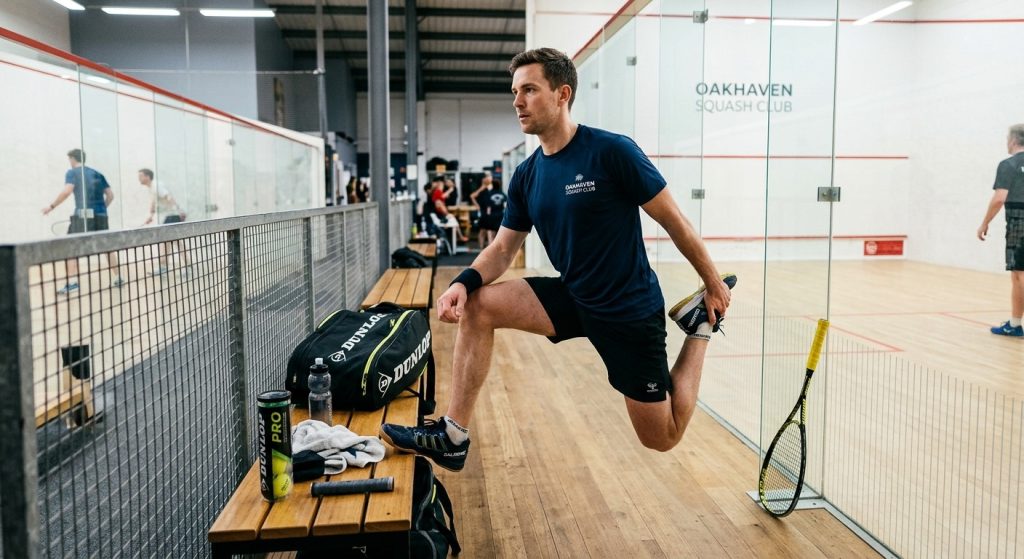
You arrive at the club ten minutes before your booking, change, do a few arm swings on court, and your opponent is already waiting at the service box. That pattern costs you points before you’ve hit a single ball in anger. A structured pre-match routine, built around what your body and mind genuinely need, changes that entirely.
A deliberate pre-match routine separates players who step on court focused from those who step on court rushed.
- Physical preparation should start at least 60 minutes before your match, not as you walk through the club door.
- Mental wind-down is as important as physical warm-up, and it begins well before your first rally.
- Phone habits at the club are one of the most underestimated saboteurs of pre-match focus.
Getting the Body Ready Before You Touch a Racket
When you arrive at the club, your body is carrying whatever your day loaded onto it. Eight hours at a desk, a commute, a difficult afternoon. Your muscles have no idea there is a squash match coming. They need gradual signalling, not a sudden demand to sprint, twist, and lunge.
Start with five to ten minutes of low-intensity movement away from the court. A brisk walk around the building, a few minutes on a stationary bike, or walking lunges in the corridor. The purpose is to raise your core temperature gradually, getting blood flowing to the muscles you will depend on. The science behind pre-exercise warm-up is consistent: heart rate and joint mobility need to increase progressively before any significant load is applied to the body.
From there, move into dynamic stretching. Leg swings forward and back, hip circles, shoulder rotations, and lateral shuffles. You are not trying to improve your flexibility right now. You are waking up the joints and priming the movement patterns your body will rely on across 40 minutes of match play. Give this a full ten minutes and stay present throughout it. Don’t treat it as dead time.
Building Court Awareness Before the Ball Even Bounces
Once your body is moving freely, get onto a court or a suitable space to ghost. Ghosting is one of the most underused preparation tools at club level. Players tend to think of it purely as a fitness drill. In reality, it is a precision movement rehearsal. Stepping to each corner, touching the wall, recovering cleanly to the T, and repeating this sequence conditions your legs and your spatial sense to the specific geometry of that court.
Five to eight minutes of ghosting at a moderate pace is enough. Pay particular attention to your recovery step back to the T after each corner touch. That is where most club players lose time during matches, not in the extension to the ball, but in the recovery from it. Get that movement pattern sharpened before your opponent arrives.
When court time opens up, start with solo hitting at reduced intensity. Feed the ball to yourself, move to it smoothly, and focus on the quality of contact rather than the pace of the shot. The sport’s governing body advises players to progress from low-intensity movement through to match-intensity hitting in stages, rather than jumping straight into hard-driving rallies that shock muscles still warming through.
What to Include in Your Solo Hitting Session
- Straight drives from mid-court, prioritising length and height over the tin rather than raw pace
- Cross-court drives to reconnect with angle control and court width
- Drops from both front corners, slow and deliberate at around 60 percent effort
- Boasts from the back corners to check that your footwork is placing you well at the point of contact
- Volleys from the T area, intercepting mid-height feeds to sharpen reaction timing
Keep intensity low and attention high throughout. You are not trying to peak here. You are reminding your muscle memory of what it already knows.
The Phone in Your Pocket Is Fragmenting Your Preparation
Here is where a large number of club players quietly lose their edge without noticing it.
You have had a decent warm-up. You are on the T, feeling reasonably settled. Then you head back to your bag, pick up your phone, and start scrolling. A message, a check of notifications, and then you spot that your team is 2-0 down. You pull up the football scores to see what is happening at half-time. Eight minutes disappear. Your heart rate has dropped, your focus has scattered across three different mental threads, and your match starts in two minutes.
This is not a trivial distraction. Attention is a finite resource. Filling the gap before a squash match with fragmented screen time asks your brain to switch modes at precisely the moment it needs to narrow. Sports psychologists describe a concept called the pre-performance state, the internal mental environment that allows you to compete at your best. That state takes time and intention to build, and it can be undone in seconds by a notifications feed.
The fix is straightforward. Put your phone away before your warm-up begins and leave it there until after the final point. If you have spare time at the club before your slot, talk to someone, have a drink of water, or sit quietly for a few minutes. Any of those options serves your squash far better than a screen.
Using Breathing to Settle the Nervous System
The final 15 minutes before your match are for mental tuning, not additional physical work. Your body is warm. Your shots are primed. Your one remaining task is to settle your head.
Controlled breathing is the most accessible performance tool any club player has. Box breathing works particularly well in this context: inhale for four counts, hold for four, exhale for four, hold for four. Run this cycle for three to five minutes. It activates the parasympathetic nervous system, calming the physical symptoms of pre-match nerves without blunting your alertness or competitive edge.
Alongside your breathing, run a brief mental walk-through of your game plan. Not tense or laboured. More like a quiet rehearsal. Picture a few rallies going your way. Think about where you want to play the ball against this specific opponent, their weaker side, their preferred court position, their pace preferences. Keep this brief and positive. The goal is to arrive on court feeling settled and purposeful, with clear intent rather than vague anxiety.
Making This Routine Work Within the Reality of Club Life
The challenge at club level is logistics. Court bookings are tight, corridors are shared, and not every facility has a dedicated warm-up space. Building this routine requires deliberate management of your arrival time, not your session time.
If your match starts at 7:30pm, aim to arrive at 6:30pm. A full hour gives you room to work through the complete routine without the final ten minutes collapsing into a rushed scramble. If that feels like a long time, consider what you are actually paying for when you book a court. Not just 40 minutes of play, but the opportunity to perform well within those 40 minutes. Arriving with ten minutes to spare wastes most of that opportunity before the first serve.
Talk to regular hitting partners about warming up together before your bookings. Even 15 minutes of structured rallying before a match benefits both players. Most club members are open to it if you ask and explain the reasoning. You might find they have been wanting to do exactly the same thing for months.
It also helps to treat the routine as a fixed sequence rather than a list of optional extras. Once the order of activities becomes automatic, the psychological benefit compounds. The routine itself signals to your brain that competition is approaching, narrowing your focus without you having to force it.
The Player Who Steps On Court Ready, Not Just Present
The difference between a player who has run this routine and one who hasn’t is visible from the gallery within the first three rallies. The prepared player moves with intention from the opening point. Their length is controlled from the start. Their drops carry conviction rather than hesitation. They are not scrambling to find their game across the first game because their game was already found before the knock-up began.
None of this requires specialist coaching time or expensive equipment. It requires only that you treat the 60 to 90 minutes before your match as part of the match itself. The preparation window is not dead time you wait through. It is the foundation your performance is built on.
Run this routine consistently for a month and pay attention to how your first game changes. More movement from the opening rally, better length under pressure, cleaner decisions when the score gets tight. That is where the investment shows up first.
The work starts when you walk through the club door. Not when the referee says love all.